
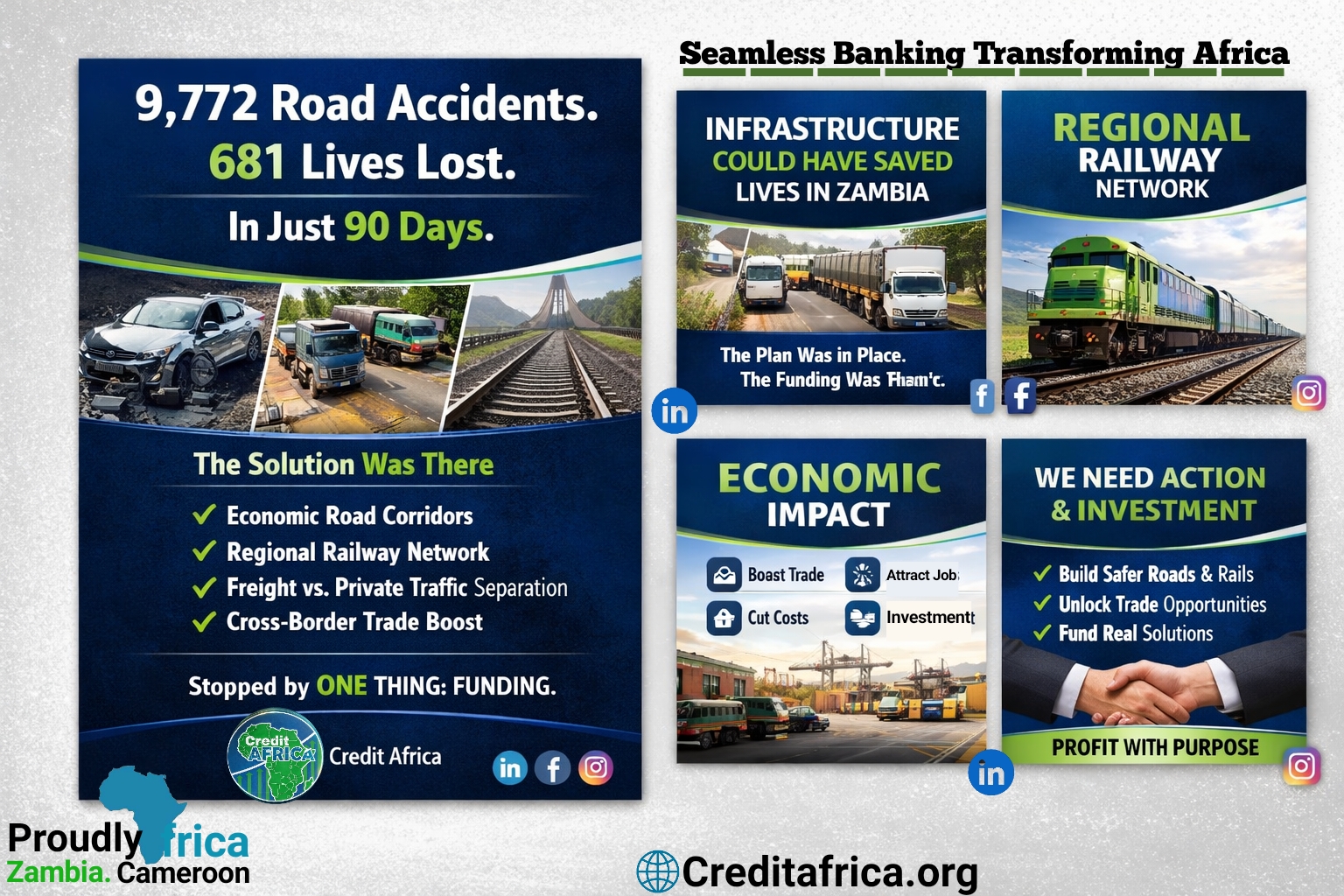
Road Safety Crisis in Zambia: A Wake-Up Call for Infrastructure Investment
In the first quarter of 2026, Zambia recorded 9,772 road traffic accidents, resulting in 681 fatalities. These figures, confirmed by Godfrey Chilabi, are more than statistics—they represent a growing national crisis with deep economic and social consequences.
But beyond the numbers lies a critical question:
What Is This Telling Us?
It tells us that Zambia—and much of Africa—is facing a structural infrastructure challenge.
Road congestion, heavy freight traffic, poor transport planning, and lack of modern logistics systems are not just mobility issues. They are economic bottlenecks and public safety risks.
This is not an unforeseen problem.
A Solution Was Already on the Table
In February 2025, the Credit Africa Business Development team engaged with government stakeholders to proactively address this looming crisis.
The discussions were centered on a transformational infrastructure strategy, including:
- Reconstruction of key road networks
- Prioritization of high-economic activity corridors
- Strengthening cross-border connectivity with neighboring countries
- Integration of logistics systems to support trade and industrial growth
The goal was clear: build infrastructure that saves lives while accelerating economic activity.
The Railway Revolution: A Missed Opportunity
A cornerstone of this proposal was the development of a regional railway system.
This was not just a transport project—it was an economic lifeline.
The railway was designed to:
- Connect Zambia to nine neighboring countries, positioning the country as a regional logistics hub
- Reduce the burden of heavy trucks on public roads
- Enable efficient transportation of raw materials, minerals, and industrial goods
- Lower road accident risks significantly
By shifting freight from road to rail, Zambia could have drastically reduced traffic congestion and improved road safety outcomes.
Saving Lives Through Smart Infrastructure
The reality is simple:
Many of these 681 lives could have been saved.
The proposed model also introduced a forward-thinking concept:
- Separation of commercial freight routes from private road users
This is a globally proven system that:
- Enhances road safety
- Improves transport efficiency
- Reduces wear and tear on infrastructure
- Supports long-term urban and economic planning
The Economic Impact: Beyond Safety
Investing in infrastructure is not just about preventing accidents—it is about unlocking national and regional prosperity.
Key Economic Benefits:
1. Increased Trade Efficiency
Faster and safer movement of goods across borders boosts intra-African trade and supports the vision of the African Continental Free Trade Area.
2. Industrial Growth
Reliable transport systems attract manufacturing, mining, and agricultural investments.
3. Job Creation
Large-scale infrastructure projects generate employment across construction, logistics, and operations sectors.
4. Reduced Cost of Doing Business
Efficient logistics lower operational costs for businesses, increasing competitiveness.
5. Investor Confidence
Structured, scalable infrastructure projects provide strong returns while solving real-world problems.
The Challenge: Funding
Despite its strategic importance and approval, the project faced one major barrier:
Funding.
This highlights a recurring challenge across Africa—bankable, high-impact projects exist, but access to structured financing remains limited.
A New Approach: Profit with Purpose
At Credit Africa, we believe in a simple but powerful philosophy:
Solve critical problems first—profit and wealth creation will follow.
Our model is built on:
- Identifying systemic challenges
- Designing scalable, multi-country solutions
- Structuring projects that deliver both financial returns and social impact
This is not just infrastructure development.
This is nation-building with investor participation.
The Way Forward
Zambia’s road safety crisis is not isolated—it reflects a broader continental opportunity.
The question is no longer whether these projects are needed.
The question is:
Who will step forward to fund and implement them?
Investor & Partner Call-to-Action
We are actively engaging:
- Institutional investors
- Infrastructure funds
- Development finance institutions
- Strategic partners
To unlock this and similar projects across Africa.
If you are looking to invest in high-impact, scalable infrastructure with strong long-term returns, we invite you to connect with us.
Because the future of Africa will not just be discussed—
it will be built.
Follow Us on Facebook & LinkedIn: Credit Africa