
Overcoming Barriers: Navigating Challenges to Successfully Invest in African SMEs
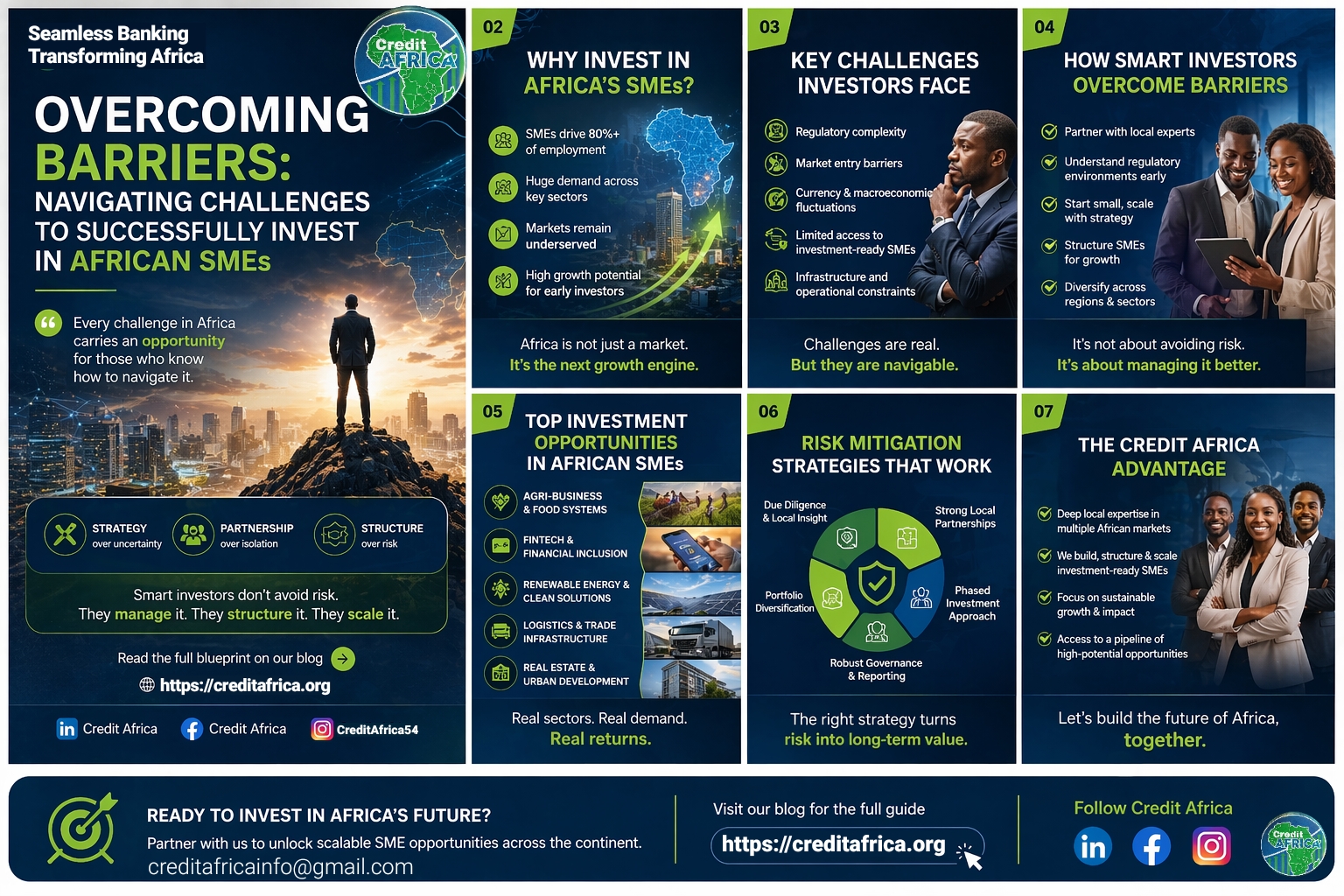
Africa’s SME sector represents one of the most compelling investment opportunities globally.
Yet, for many investors, the hesitation is not about potential,
it is about perceived complexity.
Questions around regulation, market entry, risk exposure, and execution often slow down capital deployment.
But here’s the reality:
The barriers to investing in African SMEs are real,
but they are navigable, manageable, and often misunderstood.
For investors who approach the market strategically, these challenges are not obstacles.
They are entry points to competitive advantage.
Understanding the Landscape: Risk vs. Opportunity
Every high-growth market comes with complexity.
Africa is no different.
However, what distinguishes successful investors is not avoidance of risk, but mastery of it.
Key challenges include:
- Regulatory variation across countries
- Limited access to structured SME pipelines
- Market entry and operational setup complexities
- Currency and macroeconomic fluctuations
The difference lies in how these are approached.
1. Navigating Regulatory Environments
Africa is not a single regulatory system, it is a collection of diverse legal and policy frameworks.
This can seem daunting at first.
But it also creates strategic positioning opportunities.
How Smart Investors Navigate This:
✔️ Local Partnerships
Working with in-country operators and institutions who understand compliance requirements.
✔️ Regional Strategy Over Single-Market Entry
Leveraging frameworks like the African Continental Free Trade Area to scale beyond one jurisdiction.
✔️ Engaging Early with Policy Stakeholders
Aligning projects with national development priorities increases approval speed and support.
2. Market Entry Challenges: From Access to Execution
Entering African markets requires more than capital, it requires contextual understanding.
Challenges include:
- Identifying credible local partners
- Understanding consumer behavior
- Navigating informal market structures
Mitigation Strategies:
✔️ Phased Market Entry
Start with high-impact pilot projects before scaling.
✔️ Embedded Local Expertise
Invest alongside or through platforms with established on-ground presence.
✔️ Sector-Focused Approach
Target industries with clear demand signals (agriculture, energy, fintech, logistics).
3. Structuring Investment-Ready SMEs
One of the biggest gaps in Africa is not opportunity, but structure.
Many SMEs are:
- High-potential
- Market-relevant
- But not investment-ready
Solution: Build, Then Invest
✔️ Business formalization and governance
✔️ Financial structuring and reporting systems
✔️ Scalable operational models
This transforms SMEs from informal businesses into bankable assets.
4. Managing Financial and Currency Risks
Currency volatility and macroeconomic shifts are valid concerns.
But they are also manageable with the right frameworks.
Risk Mitigation Approaches:
✔️ Diversification across multiple markets
✔️ Structuring deals in stable or blended currencies
✔️ Long-term investment horizons aligned with growth cycles
5. Infrastructure and Operational Constraints
In some regions, infrastructure gaps (transport, energy, logistics) can affect operations.
However, this is where opportunity meets necessity.
Strategic Advantage:
Investing in or alongside infrastructure-supporting SMEs:
- Logistics companies
- Energy solutions
- Supply chain platforms
These businesses don’t just operate within the system, they strengthen it.
The Real Advantage: Early Movers Win
Many investors wait for:
- Perfect systems
- Fully developed markets
- Zero friction environments
By then, the highest returns are already gone.
In Africa:
Complexity is not a barrier—it is a filter.
It separates:
- Passive capital
from - Strategic, high-return capital
The Credit Africa Approach
At Credit Africa, we focus on de-risking through structure and execution.
Our model is built on:
- Local market expertise in Zambia, Cameroon, and beyond
- Structured SME development and investment readiness
- Multi-market scalability across the continent
- Alignment with investor expectations and risk frameworks
We don’t just present opportunities.
We build them, structure them, and scale them.
From Challenge to Opportunity
The barriers to investing in African SMEs are real.
But they are also:
- Predictable
- Manageable
- And strategically exploitable
For investors willing to:
- Engage deeply
- Partner locally
- Think long-term
Africa offers not just returns—
But transformational investment outcomes.
Investor Call-to-Action
We are actively working with:
- Institutional investors
- Private equity firms
- Development finance institutions
- Strategic partners
To navigate and unlock high-potential SME investments across Africa.
If you are looking to invest where complexity creates opportunity and structure drives returns,
Africa’s SME sector is where you should be.
Connect with us to explore structured, investment-ready opportunities across Africa.