Is Africa good for investment
Africa’s Investment Narrative Is Changing
For decades, global conversations about Africa have been dominated by outdated assumptions:
- “Africa is too risky”
- “Africa depends on aid”
- “There is no scalable market”
- “Infrastructure is too weak”
But the reality in 2026 tells a different story.
Africa is increasingly becoming a continent defined by:
✔ Economic resilience
✔ Digital transformation
✔ Infrastructure investment
✔ SME expansion
✔ Rising domestic capital
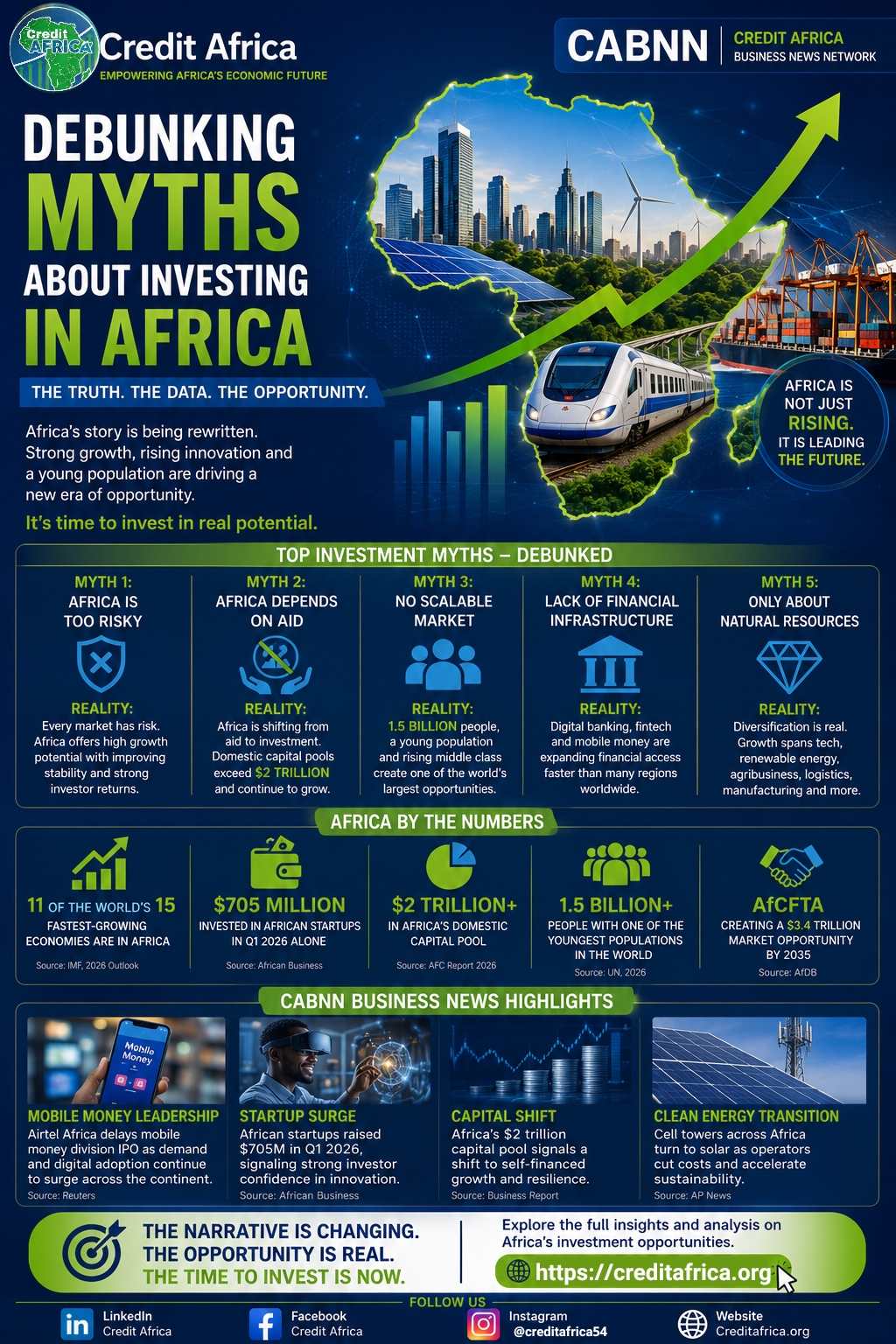
In fact, 11 of the world’s 15 fastest-growing economies are now in Africa, with regional growth projected above the global average.
The question is no longer whether Africa is investable.
👉 The real question is whether investors are paying attention early enough.
Myth #1: “Africa Is Too Risky for Investment”
✅ Reality: Risk Exists Everywhere, But Africa Offers High-Growth Potential
Every emerging market carries risk.
Yet investors continue entering:
- Southeast Asia
- Latin America
- Middle Eastern growth markets
Africa should be viewed through the same lens: 👉 Risk balanced against opportunity
Today, Africa is attracting capital into:
- Infrastructure
- Fintech
- Renewable energy
- Logistics
- Agriculture
- Critical minerals
Venture capital investment into African startups reached $705 million in Q1 2026 alone, showing increasing investor confidence in the continent’s innovation ecosystem.
Myth #2: “Africa Depends Entirely on Foreign Aid”
✅ Reality: Africa Is Transitioning From Aid to Investment
One of the biggest misconceptions is that Africa survives primarily on aid.
But the data shows a major structural shift:
- Foreign investment
- Domestic capital pools
- Trade integration
- Remittances
are becoming stronger economic drivers than aid itself.
Africa’s domestic capital pools have now surpassed $2 trillion, signaling growing financial independence and self-financed growth potential.
Recent analysis also highlights that Africa is increasingly becoming:
“an investment story, not an aid story.”
Myth #3: “Africa Has No Scalable Consumer Market”
✅ Reality: Africa Has One of the World’s Largest Untapped Markets
Africa’s population exceeds 1.5 billion people, with one of the youngest populations globally.
By 2050:
- Africa is projected to have the world’s largest workforce
- Urbanization will accelerate consumer demand
- Digital adoption will reshape commerce and finance
This creates enormous opportunities in:
✔ Fintech
✔ E-commerce
✔ Logistics
✔ Energy
✔ Telecommunications
✔ Agro-processing
The African Continental Free Trade Area (AfCFTA) is also unlocking a massive continental market for SMEs and cross-border trade.
Myth #4: “Africa Lacks Financial Infrastructure”
✅ Reality: The Gap Is Narrowing Rapidly
Africa’s challenge is no longer a lack of opportunity.
According to industry reports:
“Africa does not have a growth problem. It has a financial infrastructure gap.”
Digital banking, mobile money, and fintech platforms are expanding financial access faster than many expected.
Telecom and fintech growth are transforming:
- Payments
- Savings
- Lending
- SME financing
- Cross-border transactions
Companies like Airtel Africa and Safaricom continue reporting strong growth driven by digital adoption across African markets.
Myth #5: “Africa Is Only About Natural Resources”
✅ Reality: Africa’s Economy Is Diversifying Fast
Yes, Africa remains rich in:
- Copper
- Cobalt
- Lithium
- Oil and gas
But investment is increasingly moving into:
✔ Renewable energy
✔ AI and digital infrastructure
✔ Agritech
✔ Logistics
✔ Manufacturing
✔ Financial technology
Africa’s solar and clean energy transition is accelerating as businesses invest in sustainable infrastructure and energy resilience.
CABNN Business News Highlights
🔹 African Startups Raised $705 Million in Q1 2026
Investor confidence in Africa’s tech ecosystem continues to rise, with fintech, logistics, and agritech attracting major funding.
🔹 Africa’s Domestic Capital Surpasses $2 Trillion
African financial institutions, pension funds, and sovereign capital are increasingly financing the continent’s growth internally.
🔹 Telecom & Mobile Money Expansion Continues
Digital services and mobile money platforms are driving financial inclusion and stronger corporate earnings across Africa.
🔹 Renewable Energy Investments Accelerate
African telecom operators and businesses are shifting toward solar-powered infrastructure to reduce costs and improve resilience.
What Smart Investors Are Beginning to Understand
Global investors are increasingly recognizing that Africa offers:
✔ Long-term demographic growth
✔ Untapped industries
✔ Rapid digital adoption
✔ Infrastructure expansion
✔ Growing regional trade integration
At the same time, global supply chains are shifting, and Africa is positioning itself as a future manufacturing and industrial hub.
Community discussions across investor platforms increasingly reflect growing long-term interest in Africa’s markets, technology ecosystems, and industrial potential.
The Reality Check: Africa Still Has Challenges
Balanced analysis matters.
Africa still faces:
- Debt pressures
- Political instability in some regions
- Infrastructure gaps
- Currency volatility
S&P estimates Africa faces over $90 billion in debt repayments in 2026.
But challenges alone do not define markets.
👉 In many cases, they create the very opportunities investors seek.
CABNN Perspective: Africa Is Being Repriced by the World
The narrative is shifting from:
❌ Aid
❌ Instability
❌ Dependency
To:
✔ Investment
✔ Infrastructure
✔ Innovation
✔ Economic integration
Africa is no longer simply a “frontier market.”
It is becoming one of the world’s most strategic growth regions.
📣 The Biggest Risk May Be Ignoring Africa
The myths about Africa are fading.
The data is becoming clearer.
The opportunities are expanding.
And while risks remain, Africa’s transformation is already underway.
The biggest mistake investors can make is not understanding Africa soon enough.
🌐 About CABNN
Credit Africa Business News Network (CABNN) delivers strategic insights, investment trends, SME growth opportunities, and economic analysis shaping Africa’s future.
👉 Explore more insights at: Creditafrica.org