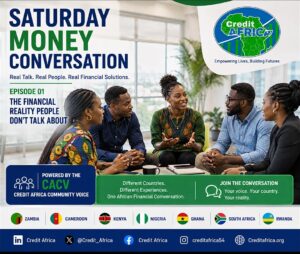
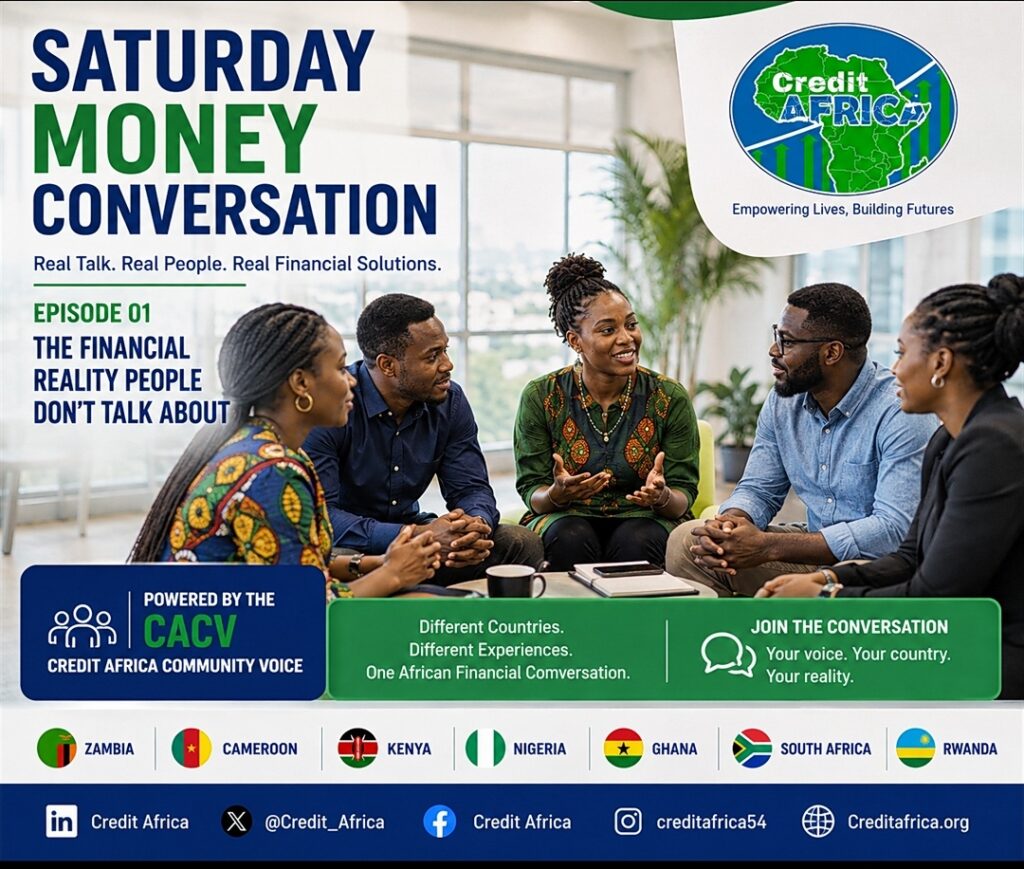
THE FINANCIAL REALITY PEOPLE DON’T TALK ABOUT
Why are millions of Africans working hard, earning money and running businesses, yet still struggling to build wealth?
Host: Credit Africa Community Development Manager (CCDM)
Community Participants:
Credit Africa Community Voices (CACVs)
🇿🇲 Zambia | 🇨🇲 Cameroon | 🇰🇪 Kenya | 🇳🇬 Nigeria | 🇬🇭 Ghana | 🇿🇦 South Africa | 🇷🇼 Rwanda
The CACVs are followers, community members and observers of Credit Africa who voluntarily join the conversation to share their personal experiences, perspectives and financial realities.
OPENING: CCDM
“Welcome to the Credit Africa Saturday Money Conversation.
All week, we have been having conversations about something that affects millions of African households, workers and entrepreneurs:
The Financial Reality People Don’t Talk About.
We work hard.
We wake up early.
We run businesses.
We trade in markets.
We farm.
We provide services.
We drive.
We build.
We create.
We send our children to school.
We support our families.
We help our communities.
Yet somehow, many people reach the end of the month with little or nothing left.
And after years of working, many still don’t have meaningful savings, investments or productive assets.
So tonight, we are not here to simply tell Africans:
‘Work harder.’
We are asking a deeper question:
Is the way we earn, manage, save, borrow and deploy money actually helping us build wealth?
And this is not a conversation for financial experts alone.
Tonight, we hear directly from members of the Credit Africa community across Africa.
Different countries. Different experiences. One financial conversation.
Let’s talk.”
🇿🇲 ZAMBIA
Income, Inflation & Everyday Survival
CCDM asks:
“From your experience in Zambia, why can someone be working hard, earning an income and still feel financially stuck?”
Credit Africa Community Voice Zambia
Conversation direction:
– Income versus rising living costs
– Food, transport, housing and education
– Debt and monthly repayments
– Lifestyle pressure
– The difference between earning and accumulating wealth
CCDM follows up:
“So is working hard enough?
Or do we also need to learn how to make the money we earn work for us?”
🇨🇲 CAMEROON
The Roadside Business Is an Economy
CCDM asks:
“Across Cameroon, millions of people operate small businesses every day, traders, food vendors, mechanics, farmers, transport operators and service providers.
They generate income.
Why doesn’t that economic activity automatically become wealth?”
Credit Africa Community Voice Cameroon
Conversation direction:
– Informal businesses
– Daily cash flow
– Mixing business and household money
– Lack of financial records
– Reinvesting versus consuming
– Building assets from a small business
CCDM follows up:
“So perhaps the problem isn’t that people aren’t economically active.
The problem is that economic activity doesn’t always become accumulated wealth.”
🇰🇪 KENYA
Financial Inclusion vs Financial Literacy
CCDM asks:
“Kenya has developed a strong digital financial ecosystem.
But can access to financial services create wealth if people don’t understand how to use those services effectively?”
Credit Africa Community Voice Kenya
Conversation direction:
– Digital payments
– Mobile money
– Digital borrowing
– Saving
– Spending
– Financial discipline
– Understanding debt
CCDM follows up:
“Access gives people financial tools.
But financial literacy teaches people how to use those tools responsibly.
Perhaps we need both.”
🇳🇬 NIGERIA
The Businesses Banks Don’t See
CCDM asks:
“A small Nigerian entrepreneur may sell products every day and generate real revenue, yet still struggle to obtain affordable formal credit.
Why?”
Credit Africa Community Voice Nigeria
Conversation direction:
– Revenue versus profit
– Business records
– Bank statements
– Credit history
– Formal accounts
– Collateral
– Tax records
– Trust between entrepreneurs and financial institutions
CCDM follows up:
“The entrepreneur says:
‘My business is working.’
The financial institution asks:
‘Can you prove it?’
And that gap can determine whether a business gets financed or remains invisible.”
🇬🇭 GHANA
Why Saving Alone Is Not Enough
CCDM asks:
“We are constantly told to save.
But can saving alone make someone wealthy?”
Credit Africa Community Voice Ghana
Conversation direction:
– Emergency savings
– Inflation
– Purchasing power
– Investment
– Productive assets
– Long-term wealth creation
CCDM follows up:
“Saving is important.
But saving may be the beginning of the journey not the destination.
The bigger question is:
What are we eventually doing with the money we save?”
🇿🇦 SOUTH AFRICA
Family Responsibilities & Family Wealth
CCDM asks:
“Across Africa, family responsibilities can be significant.
Parents support children.
Children support parents.
Relatives support relatives.
How does this affect wealth creation?”
Credit Africa Community Voice South Africa
Conversation direction:
– Supporting extended family
– Education costs
– Emergencies
– Helping relatives
– Personal financial goals
– Family financial planning
– Building wealth across generations
CCDM follows up:
“Helping family is part of our social reality.
But how do we build a financial system where supporting others doesn’t permanently destroy our own financial foundation?”
🇷🇼 RWANDA
Becoming Financially Visible
CCDM asks:
“We have talked about businesses that financial institutions struggle to see.
What can an ordinary entrepreneur do to become more financially visible?”
Credit Africa Community Voice Rwanda
Conversation direction:
– Separating business and personal money
– Keeping records
– Tracking revenue and expenses
– Understanding profit
– Using appropriate formal financial services
– Building transaction history
– Formalization where appropriate
CCDM follows up:
“Financial records are not simply paperwork.
They tell the story of your business.
And over time, that story can help demonstrate that your business is real, active and financially credible.”
THE PAN-AFRICAN QUESTION
CCDM asks every CACV:
“Let me put one question to everyone:
Is Africa’s financial challenge simply that people don’t have enough money?
Or is part of the challenge that we haven’t built enough systems, knowledge and habits that help people turn income into wealth?”
Share your thoughts below at the comments section👇
The objective is not to produce identical answers.
Different countries should produce different perspectives.
THE COMMUNITY JOINS THE CONVERSATION
Now the CCDM brings the Credit Africa online community into the discussion.
QUESTION 1:
If your income doubled tomorrow, what would you do first?
A. Save
B. Invest
C. Pay debt
D. Start a business
E. Improve your lifestyle
QUESTION 2:
What is the biggest financial mistake people make in your country?
QUESTION 3:
Can someone become wealthy from a small informal business?
QUESTION 4:
What is harder where you live, earning money or keeping it?
QUESTION 5:
Should African financial institutions change the way they assess small businesses?
QUESTION 6:
What financial lesson do you wish someone had taught you when you were younger?
QUESTION 7:
What is one financial decision you made that changed your life for better or worse?
The CCDM selects comments from followers across different African countries and brings them into the live conversation.
THE BIG LESSON
CCDM
“After seven days of conversation, perhaps the biggest lesson is this:
Africa does not lack people who work hard.
Africa does not lack entrepreneurs.
Africa does not lack economic activity.
And Africa certainly does not lack ambition.
But too many people are trapped somewhere between:
EARNING MONEY
and
BUILDING WEALTH.
We need to learn how to move:
Income → Financial Control → Saving → Investment → Productive Assets → Wealth
And for entrepreneurs:
Daily Sales → Records → Profit → Reinvestment → Creditworthiness → Growth → Assets
For families:
Income → Planning → Protection → Investment → Assets → Intergenerational Wealth
The goal isn’t simply to make more money.
The goal is to become better at:
earning money,
managing money,
protecting money,
deploying money,
and ultimately
making money work for us.
That is the financial conversation Africa needs.
And this conversation doesn’t end today.
We’ll continue next Saturday.”
THE QUESTION WE LEAVE WITH AFRICA
👉 WHAT IS KEEPING YOU FROM BUILDING WEALTH?
👉 LOW INCOME?
👉 HIGH COST OF LIVING?
👉 DEBT?
👉 LACK OF FINANCIAL KNOWLEDGE?
👉 FAMILY RESPONSIBILITIES?
👉 LACK OF ACCESS TO CAPITAL?
👉 LACK OF INVESTMENT OPPORTUNITIES?
👉 OR OR YOUR VILLAGE PEOPLE OR SOMETHING ELSE?
Tell us:
Your country
Your reality.
Your experience.
Your perspective.
CREDIT AFRICA SATURDAY MONEY CONVERSATION
Different countries. Different experiences. One African financial conversation.