
Investor Education Series
Deepening the Conversation on African Investment Opportunities
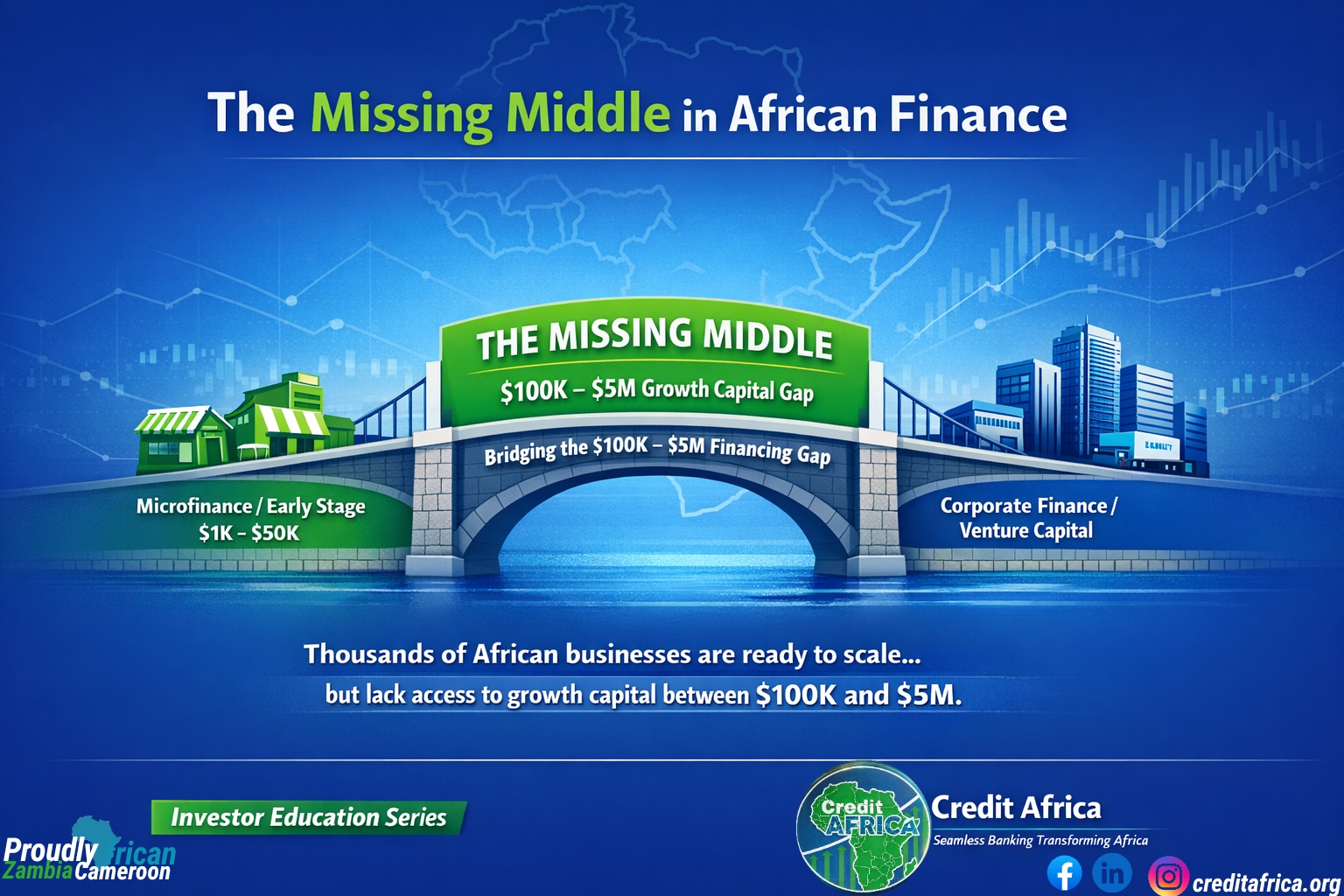
The “Missing Middle” in African Finance
Across Africa’s investment landscape, one of the most overlooked opportunities lies within what experts call the “Missing Middle.”
These are the businesses that have moved beyond startup survival but are not yet large enough to access traditional corporate financing.
Typically, they require $100,000 to $5 million in growth capital, and this is precisely where the financial system struggles to respond.
Yet these companies are often the true engines of economic expansion: scaling manufacturers, agro-processors, logistics firms, service providers, and regional distributors.
So why is this segment consistently underserved?
- Why Traditional Banks Avoid Mid-Sized SME Lending
Commercial banks tend to prioritize either:
- Large corporates with strong balance sheets, or
- Small consumer lending with standardized risk models
Growth-stage SMEs often fall in between.
They may lack:
- long operating histories
- sufficient collateral
- audited financial structures
From a banking perspective, these loans appear costly to evaluate and difficult to structure, despite their strong growth potential.
- Why Venture Capital Often Looks Elsewhere
On the other side of the market, venture capital typically concentrates on high-growth technology startups that can scale rapidly and produce outsized returns.
Traditional SMEs , manufacturing firms, agribusinesses, and service companies , rarely fit the venture capital growth model, even though they generate real economic value.
This leaves a critical financing gap.
- The Growth-Stage Financing Gap
As a result, thousands of viable African businesses face a paradox:
- They are too large for microfinance,
- too small for banks,
- and not structured for venture capital.
Yet these businesses are exactly where job creation, industrialization, and regional supply chains begin to scale.
- Emerging Financing Models for the Missing Middle
Addressing this challenge requires new approaches to capital:
- blended finance structures
- revenue-based financing
- private credit funds focused on SMEs
- development finance partnerships
- supply-chain financing platforms
These models are increasingly gaining attention as investors recognize that Africa’s most scalable opportunities may not be in startups alone, but in the businesses ready to grow.
The real question is not whether these companies exist.
The question is whether the financial system will evolve fast enough to support them.
In the coming posts in this series, we will continue exploring structural investment opportunities across African markets that remain undercapitalized but highly promising.
Follow us on Facebook | LinkedIn : Credit Africa & on Instagram: CreditAfrica54
#InvestorEducation
#AfricanInvestment
#SMEFinance
#PrivateCapital
#EconomicTransformation
#Nextbridge