
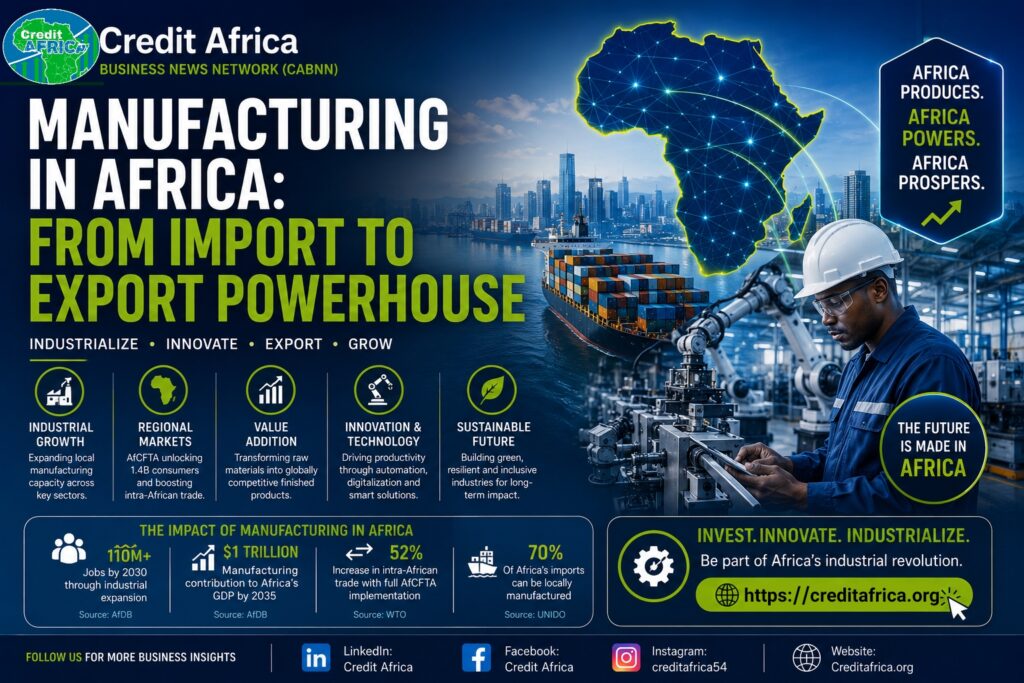
Discover how Africa’s manufacturing sector is transforming into a global export powerhouse through industrialization, AfCFTA, infrastructure development, and regional value chains. Explore investment opportunities in African manufacturing, industrial parks, export processing, and supply chain growth.
Africa’s Manufacturing Shift Is Accelerating
For decades, many African economies depended heavily on:
❌ Raw material exports
❌ Imported finished goods
❌ Limited industrial processing
Today, however, a major transformation is taking place.
Across the continent:
- Manufacturing capacity is expanding
- Regional supply chains are growing
- AfCFTA is opening larger markets
- Infrastructure investment is increasing
- Industrial parks are emerging
Africa is increasingly positioning itself to move:
👉 From import dependency toward industrial and export competitiveness.
According to the African Development Bank, manufacturing remains critical for:
✔ Job creation
✔ Industrialization
✔ Economic diversification
✔ Export growth
✔ Regional competitiveness.
CABNN Insight: Manufacturing Could Redefine Africa’s Economic Future
Manufacturing is no longer viewed only as an industrial sector.
It is increasingly becoming: A strategic economic growth engine.
Countries across Africa are investing in:
- Industrial zones
- Logistics infrastructure
- Energy systems
- Export processing hubs
- Industrial technology
to strengthen regional production ecosystems.
👉 CABNN Perspective:
Africa’s next economic chapter may be driven by industrialization and value addition.
1. AfCFTA Is Creating a Massive Manufacturing Opportunity
The African Continental Free Trade Area (AfCFTA) is reshaping industrial opportunities across Africa.
With access to a market of over: 1.4 billion people,
African manufacturers now have greater opportunities to:
✔ Scale production
✔ Access regional markets
✔ Build regional supply chains
✔ Increase exports
AfCFTA aims to reduce trade barriers and encourage regional industrial growth.
👉 CABNN Insight:
Regional integration may become one of the strongest catalysts for Africa’s manufacturing expansion.
2. Regional Value Chains Are Expanding
One of Africa’s biggest economic priorities is moving beyond:
❌ Exporting raw commodities alone.
Instead, countries increasingly aim to: – Process locally
– Manufacture regionally
– Export higher-value products
Regional value chains are emerging across:
- Agriculture processing
- Automotive assembly
- Pharmaceuticals
- Textiles
- Battery materials
Experts increasingly highlight local value addition as essential for long-term industrial competitiveness.
3. Infrastructure & Energy Are Driving Industrial Growth
Manufacturing depends heavily on:
- Reliable electricity
- Transport infrastructure
- Logistics systems
- Digital connectivity
Across Africa, governments and private investors continue expanding: ✔ Industrial corridors
✔ Ports and rail systems
✔ Energy infrastructure
✔ Smart industrial parks
Infrastructure investment remains critical for supporting industrial growth and export competitiveness.
👉 CABNN Perspective:
Infrastructure and manufacturing growth are becoming increasingly interconnected.
4. Industrial Parks Are Becoming Growth Hubs
Industrial parks and special economic zones are expanding rapidly across Africa.
These zones help businesses benefit from:
- Shared infrastructure
- Supply chain clustering
- Logistics access
- Investment incentives
Countries such as Ethiopia, Rwanda, Egypt, Kenya, South Africa, and Morocco continue investing in industrial ecosystems to attract manufacturers and exporters.
👉 CABNN Insight:
Industrial parks are helping accelerate industrialization and export capacity development.
5. Africa’s Young Workforce Creates Manufacturing Potential
Africa possesses one of the world’s youngest and fastest-growing populations.
This creates opportunities for:
- Industrial labor development
- Skills expansion
- Consumer market growth
- Factory workforce scaling
According to UN projections, Africa’s working-age population is expected to continue rising significantly over the coming decades.
👉 CABNN Perspective:
Demographics may become one of Africa’s biggest long-term industrial advantages.
6. Export-Oriented Manufacturing Is Expanding
Africa is increasingly seeking to expand: Export-oriented industries.
Growing sectors include:
- Textiles & apparel
- Automotive assembly
- Pharmaceuticals
- Agro-processing
- Green industrial materials
Manufacturing exports are becoming increasingly important for:
✔ Economic diversification
✔ Currency stability
✔ Job creation
✔ Industrial competitiveness
7. Technology Is Modernizing African Manufacturing
Digital transformation is increasingly influencing manufacturing across Africa.
Emerging technologies include:
- Industrial automation
- Smart supply chain systems
- Manufacturing analytics
- Digital trade platforms
Technology adoption is helping manufacturers improve:
✔ Productivity
✔ Efficiency
✔ Regional competitiveness
👉 CABNN Insight:
Africa’s manufacturing future may become increasingly technology-driven.
CABNN Business News Highlights
🔹 AfCFTA Expanding Industrial Trade Opportunities
Regional integration efforts continue creating larger markets for African manufacturers.
🔹 Industrial Parks Expanding Across Africa
Governments continue investing in industrial zones to support export growth and manufacturing ecosystems.
🔹 Infrastructure Investment Supporting Industrialization
Energy, transport, and logistics projects remain essential for manufacturing competitiveness.
🔹 Value Addition Becoming a Major Economic Priority
Countries increasingly seek to process raw materials locally and strengthen regional value chains.
High-Growth Manufacturing Opportunities in Africa
| Sector | Opportunity |
|---|---|
| Agro-Processing | Food & agricultural value chains |
| Pharmaceuticals | Local healthcare manufacturing |
| Automotive Assembly | Regional vehicle production |
| Textiles & Apparel | Export-oriented production |
| Industrial Materials | Construction & infrastructure growth |
| Green Manufacturing | Renewable energy supply chains |
Why Investors Are Watching African Manufacturing
Africa offers: Large untapped regional markets
1. Growing workforce potential
2. Expanding logistics systems
3. Rising regional trade integration
4. Increasing industrial policy support
The companies building scalable manufacturing ecosystems today may become: Africa’s future industrial leaders.
Challenges Still Facing Manufacturing in Africa
Despite major opportunities, challenges remain:
- Energy reliability gaps
- Infrastructure financing needs
- Logistics costs
- Skills shortages in some markets
- Regulatory complexity
However, industrialization efforts continue accelerating across multiple African economies.
CABNN Perspective: Africa’s Industrial Era Is Emerging
Africa’s manufacturing transformation is no longer a distant vision.
Across the continent:
- Industrial zones are expanding
- Infrastructure investment is rising
- Regional trade is strengthening
- Value chains are evolving
The future of African competitiveness may increasingly depend on:
✔ Manufacturing capacity
✔ Export growth
✔ Industrial innovation
✔ Regional supply chain integration
📣 Africa Is Building Toward Industrial Competitiveness
Across Africa:
- Factories are expanding
- Supply chains are improving
- Regional trade is increasing
- Industrial ecosystems are emerging
Manufacturing is becoming: A major pillar of economic transformation.
The businesses investing early in:
✔ Industrial infrastructure
✔ Regional value chains
✔ Export manufacturing
✔ Technology-driven production
may benefit significantly from Africa’s long-term industrial growth story.
Africa’s future may increasingly shift: 👉 From raw material exporter to industrial powerhouse.
🌐 About CABNN
Credit Africa Business News Network (CABNN) delivers strategic business insights, investment opportunities, SME growth strategies, and economic analysis shaping Africa’s future.