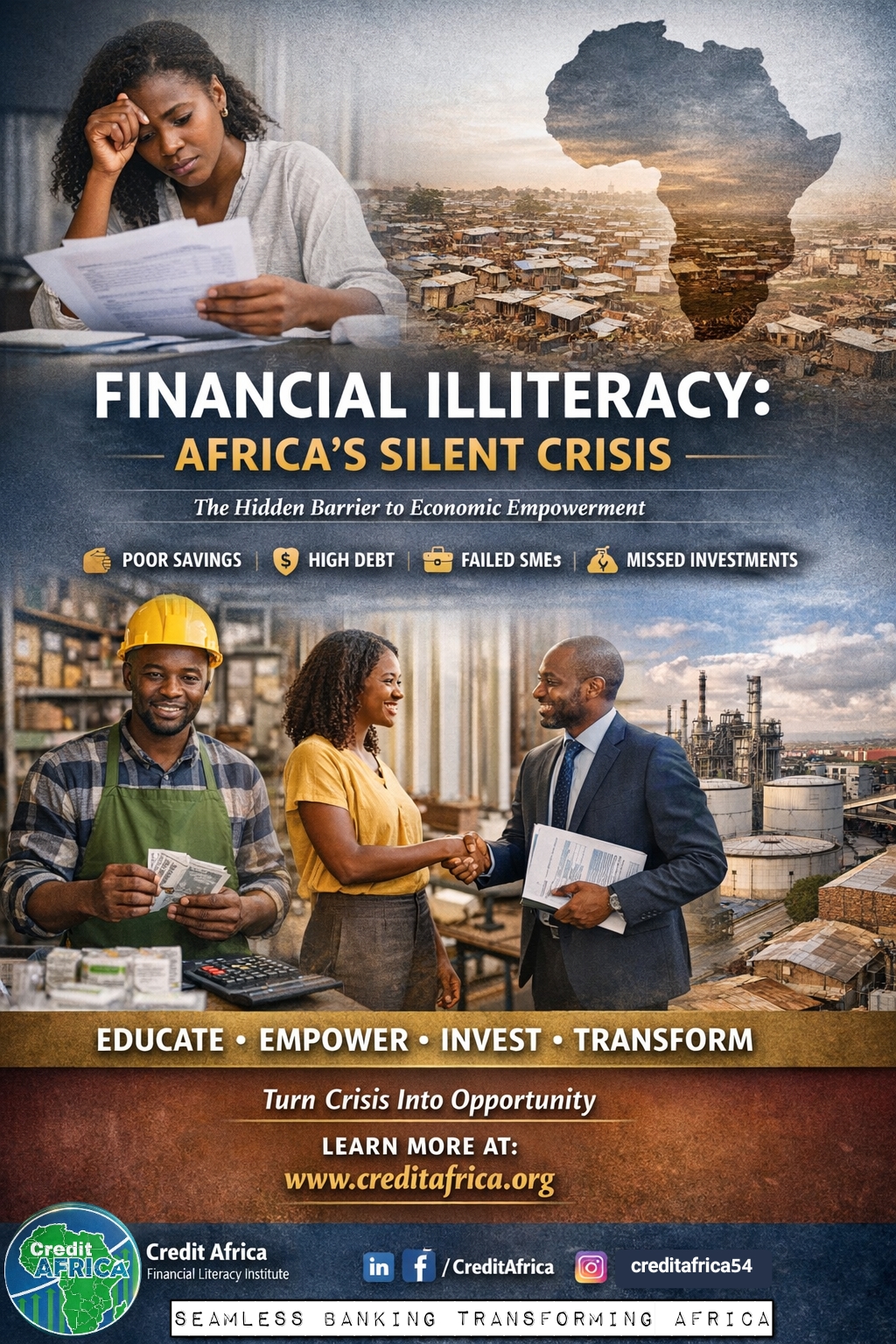
Africa is rich in resources, talent, and opportunity.
Yet across the continent, millions remain financially vulnerable, not because they lack income potential, but because they lack financial knowledge.
This is Africa’s silent crisis.
Not visible like poverty.
Not debated like politics.
But deeply embedded in everyday decisions that shape lives, businesses, and entire economies.
The Hidden Cost of Financial Illiteracy
Financial illiteracy is not just about not understanding money,
It is about mismanaging opportunity.
Across Africa, it manifests in:
– Poor saving habits
– High personal and business debt
– Lack of investment culture
– Weak business financial structures
– Limited access to formal financial systems
The result?
👉 Individuals remain trapped in survival cycles
👉 SMEs fail before reaching scale
👉 Economies remain consumption-driven rather than production-led
This is not a people problem.
It is a systems and knowledge gap problem.
From Income to Impact: Where the Breakdown Happens
Many Africans earn, but few build wealth.
Why?
Because income without financial literacy leads to:
1. Consumption over investment
2. Short-term thinking over long-term planning
3. Dependency over ownership
Even among educated professionals and entrepreneurs,
financial misalignment continues to limit growth.
This is why financial literacy must evolve beyond theory,
It must become a practical life skill for all:
– Skilled and unskilled individuals
– Professionals and entrepreneurs
– SMEs and informal sector players
Reframing Financial Literacy as Economic Infrastructure
Financial literacy is often treated as education.
But in reality, it is economic infrastructure.
Just like roads move goods,
financial knowledge moves capital efficiently.
When people understand money:
✔ They save and invest strategically
✔ They build sustainable businesses
✔ They attract and manage capital effectively
✔ They contribute to stronger, more resilient economies
This is how nations move from:
➡️ Poverty to productivity
➡️ Informality to structure
➡️ Consumption to wealth creation
The Role of Credit Africa (CAFLI)
At Credit Africa Financial Literacy Institute (CAFLI), we believe:
Financial literacy is the foundation of economic freedom.
Our mission goes beyond awareness, we focus on transformation.
We are actively:
Empowering individuals with practical financial skills
Preparing SMEs to become investment-ready
Bridging the gap between knowledge, capital, and opportunity
Supporting systems that enable sustainable wealth creation
Because true development is not aid-driven,
It is knowledge-driven and investment-enabled.
A Call to Investors & Strategic Partners
Africa’s challenge is not a lack of opportunity,
It is a lack of structured, informed participation in the economy.
This is where forward-thinking investors and partners come in.
At Credit Africa, we are advancing multiple SME-driven projects with:
1. Strong fundamentals
2. Scalable models
3. High-yield revenue potential
4. Real sector impact
These are not just investments,
They are pathways to rebuilding Africa’s economic future from the ground up.
From Crisis to Opportunity
Financial illiteracy may be a silent crisis,
But it also presents a powerful opportunity:
👉 To educate
👉 To empower
👉 To invest
👉 To transform
Africa’s future will not be defined by what we have
But by what we understand and how we act on it.
Explore Investment & Partnership Opportunities
If you are an:
Investor seeking high-impact, high-return opportunities
Institution looking to support economic transformation
Partner ready to build sustainable financial ecosystems
We invite you to engage with us.
👉 For more information on current investment opportunities and partnerships, visit:
creditafrica.org
Share & Engage
Financial literacy is everyone’s responsibility.
Share this article to spark conversations that drive real change.
#CreditAfrica
#FinancialLiteracy #EconomicFreedom #InvestInAfrica #SMEGrowth #WealthCreation #AfricaRising #ImpactInvesting #Entrepreneurship #SustainableDevelopment #CreditAfrica #FinancialEducation #BuildInAfrica