
Session Dialogue: Structuring Africa’s Entrepreneurial Power
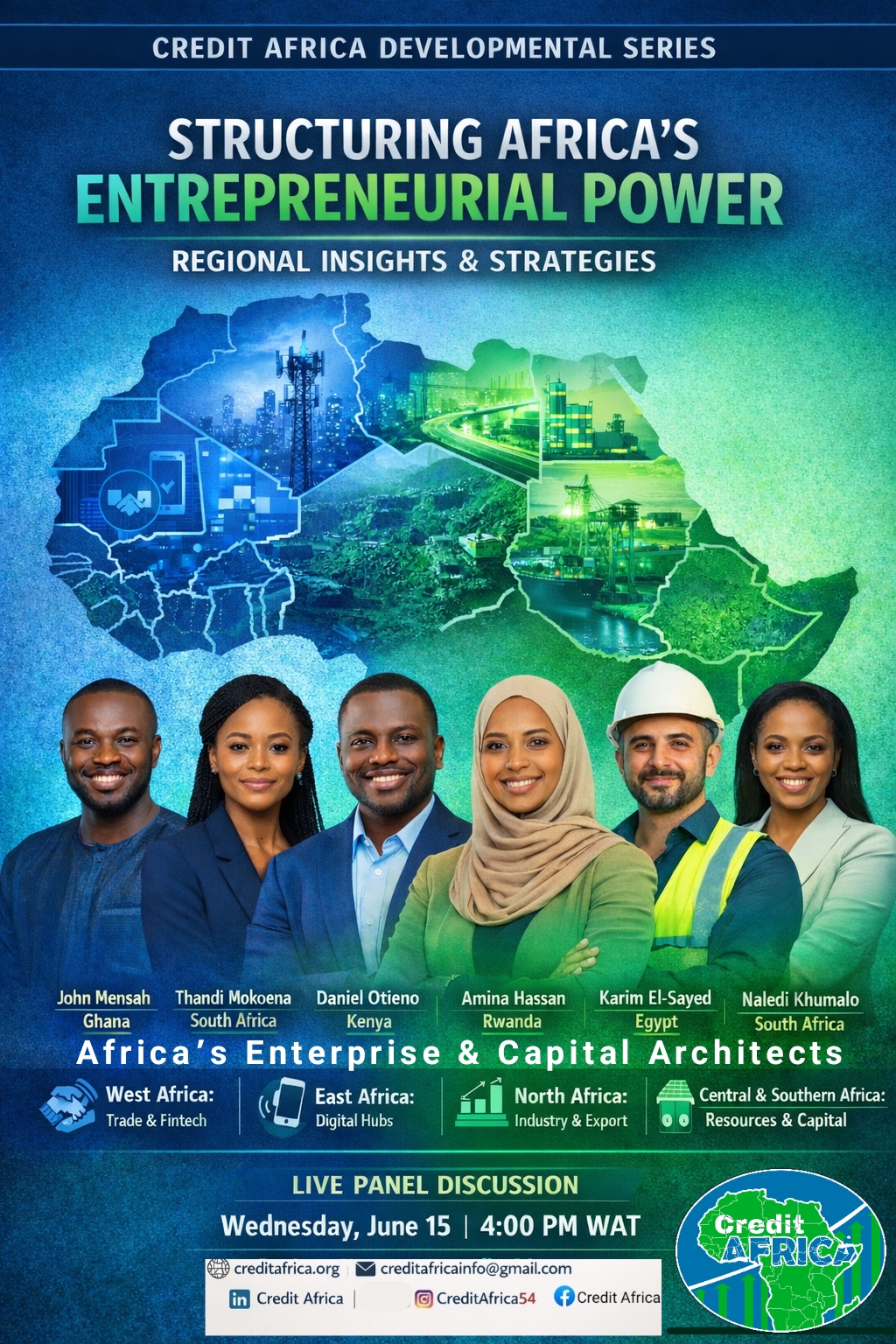
Hosted by Credit Africa
Join Credit Africa Developmental Series for a high-level continental dialogue bringing together entrepreneurs, investors, business analysts, and policy leaders from across West, East, North, Central, and Southern Africa.
This session goes beyond startup hype.
We will examine:
- How regional strengths can drive continental integration
- Why asset-backed enterprises matter more than valuations
- What investors now demand from African founders
- How policy must align with industrial growth
- Where Africa’s real structural advantage lies
Join the dialogue.
Shape the structure
Meet our participants:
John Mensah – Entrepreneur, Ghana
“West Africa thrives on trade and digital finance. In Ghana and Nigeria, fintech has unlocked payments and remittances at scale. But we must move beyond transaction-based startups.
If we truly want industrial growth, we must invest in agro-processing, light manufacturing, and export-driven SMEs. Trade is our strength, value addition must be our next frontier.”
Thandi Mokoena – Business Analyst, South Africa
“Across the continent, I see strong entrepreneurial energy, but weak enterprise architecture.
Southern Africa has relatively mature capital markets and corporate governance frameworks. However, cross-border expansion remains fragmented.
The question is not whether Africa can innovate, it is whether we can institutionalize innovation.”
Let here what happening in Digital Infrastructure & Startup Ecosystems
Daniel Otieno – Investor, Kenya
“East Africa’s strength lies in mobile-driven financial inclusion and startup ecosystems.
But investors are becoming more cautious. We are shifting from growth-at-all-costs to governance-first investing.
We are asking founders:
Where are your audited financials?
What assets back your valuation?
What is your regional expansion strategy?
Capital will follow structure.”
Amina Hassan – Economic Policy Advisor, Rwanda
“Policy stability is East Africa’s competitive advantage. Rwanda, Kenya, and Tanzania have focused on ease of doing business and regulatory clarity.
But policy must now support industrial clusters, not just startups.
Digital ecosystems must connect to manufacturing, logistics, and regional trade corridors.”
Let here from the Industrial Base & Export Capacity
Karim El-Sayed – Manufacturing Entrepreneur, Egypt
“North Africa has strong industrial capacity and access to European and Middle Eastern markets.
Our challenge is integration with Sub-Saharan Africa. We need continental supply chains, not isolated regional strengths. AfCFTA must become operational reality, not policy rhetoric.”
Leila Ben Youssef – Investment Strategist, Morocco
“North Africa’s strength is export infrastructure and manufacturing platforms.
However, investors require transparency and currency stability.
Pan-African platforms must hedge risk, build regional hubs, and structure deals with long-term asset backing.”
At the point of Natural Resources & Infrastructure Potential, let here
Patrick Mbala – Infrastructure Developer, DRC
“Central Africa holds immense mineral wealth and hydro capacity.
But without structured financing and governance reforms, resources remain under-leveraged.
We must move from extraction to processing, from raw export to refined production.”
The views on Capital Markets & Institutional Finance
Naledi Khumalo – Institutional Investor, South Africa
“Southern Africa has pension funds, stock exchanges, and structured banking systems.
We must deploy this institutional capital across the continent, not only domestically.
African capital should finance African infrastructure.”
Moderator – Credit Africa Reflection
Across all regions, we see strengths:
– West Africa → Trade networks & fintech innovation
– East Africa → Digital inclusion & startup ecosystems
– North Africa → Industrial base & export corridors
– Central Africa → Natural resources & infrastructure capacity
– Southern Africa → Institutional capital & governance systems
Yet a common theme emerges:
Africa does not lack activity.
Africa lacks structural integration.
Audience Challenge
#Entrepreneurs:
Are you building regionally integrated businesses?
#Investors:
Are you financing production or speculation?
Are your regulations aligned with continental competitiveness?
Closing Statement from Credit Africa
The next era of African entrepreneurship will not be defined by the number of startups
It will be defined by:
– Asset-backed enterprises
– Regional integration
– Institutional governance
– Structured capital deployment
Africa’s opportunity is not in fragmented success.
It is in coordinated economic architecture.
If you represent your region,
What structural strength can Africa leverage next?