
Africa’s Investment Renaissance: Why Infrastructure, Fintech, and SMEs Will Drive the Next Decade of Growth
By Credit Africa
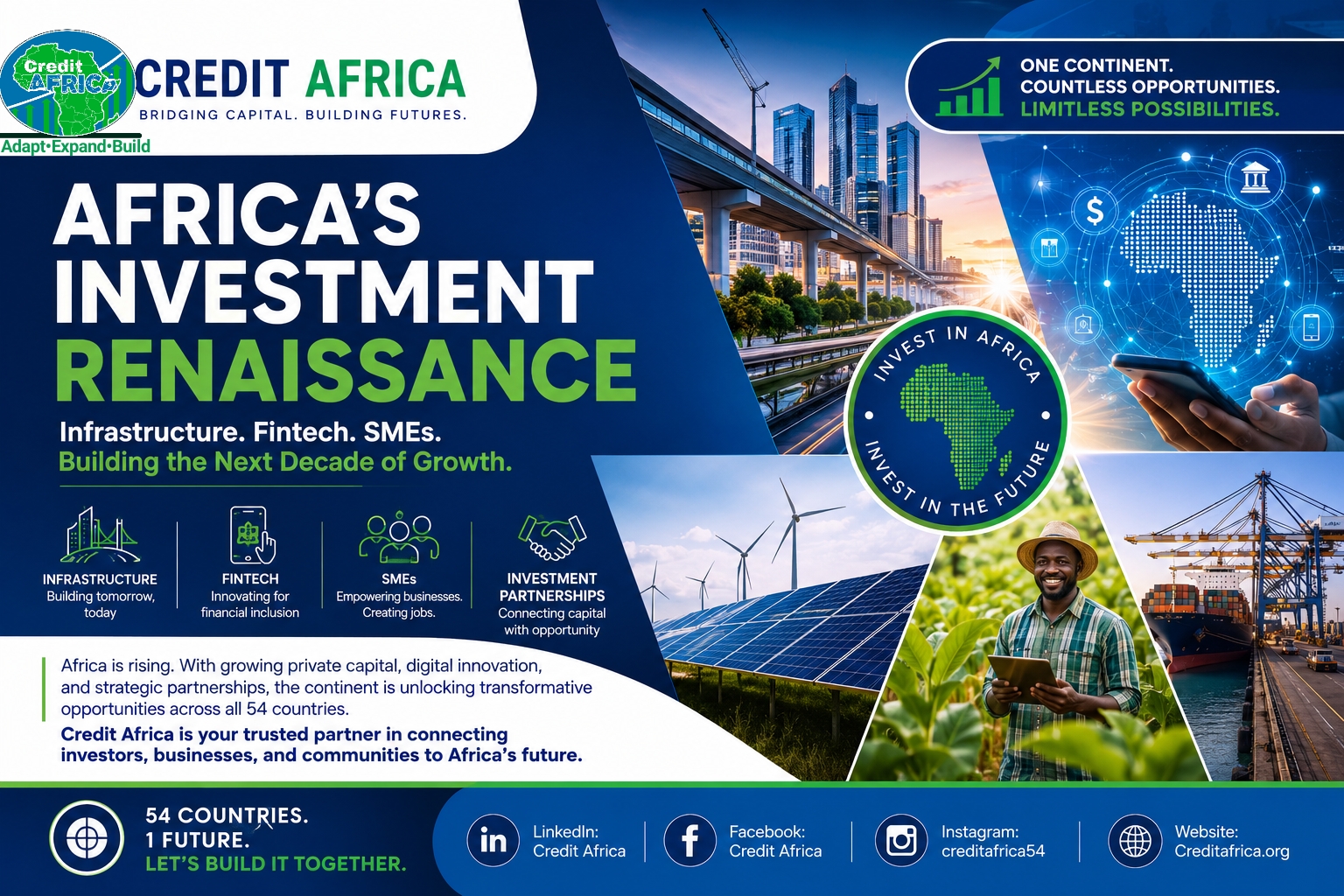
Africa stands at a defining moment in its economic transformation.
Across the continent, governments, investors, development finance institutions, entrepreneurs, and private sector leaders are working together to unlock opportunities that have the potential to reshape industries, create jobs, and accelerate sustainable economic growth.
Recent reports from leading financial institutions and international development organizations indicate growing investor interest in African markets, particularly in infrastructure development, digital transformation, financial technology, manufacturing, agriculture, mining, renewable energy, and SME financing.
This momentum signals more than just capital inflows—it reflects increasing confidence in Africa’s long-term growth potential.
The Rise of Private Capital in Africa
Private capital continues to play a critical role in financing Africa’s development agenda.
As governments seek innovative financing solutions and investors search for high-growth markets, Africa is emerging as a destination for transformative investments. Infrastructure projects, industrial parks, transport corridors, logistics networks, energy generation, and digital infrastructure are attracting increasing attention from both domestic and international investors.
The continent’s young population, expanding urban centers, improving business environments, and growing consumer markets provide a strong foundation for long-term economic expansion.
However, capital alone is not enough.
Success will depend on creating effective partnerships between investors, governments, businesses, communities, and development stakeholders.
Fintech: Transforming Financial Inclusion Across Africa
One of the most exciting developments across the continent is the rapid growth of financial technology.
Fintech is no longer limited to digital payments. Today’s fintech ecosystem is expanding into:
- SME lending
- Trade finance
- Digital banking
- Wealth management
- Agricultural finance
- Insurance technology
- Cross-border payments
- Embedded financial services
These innovations are helping bridge financial inclusion gaps while enabling entrepreneurs and businesses to access capital more efficiently.
For millions of Africans, fintech represents the gateway to formal financial services, economic participation, and business growth.
The continued evolution of digital finance presents significant opportunities for investors, innovators, and policymakers seeking scalable solutions to Africa’s development challenges.
Infrastructure Remains Africa’s Greatest Investment Opportunity
Despite remarkable progress in recent years, Africa continues to face substantial infrastructure financing gaps.
The need for investment spans several sectors, including:
Energy
Reliable and affordable energy remains essential for industrial growth, manufacturing, mining, healthcare, education, and digital transformation.
Transportation
Road networks, railways, airports, seaports, and logistics corridors are critical for regional integration and trade expansion under the African Continental Free Trade Area (AfCFTA).
Water and Sanitation
Sustainable water infrastructure is fundamental to public health, agriculture, and economic productivity.
Digital Infrastructure
Broadband connectivity, data centers, telecommunications infrastructure, and digital platforms are increasingly important drivers of economic competitiveness.
Public-Private Partnerships (PPPs) continue to offer practical mechanisms for mobilizing private investment into these critical sectors.
SMEs: The Backbone of African Economies
Small and Medium Enterprises (SMEs) account for the majority of businesses and employment opportunities across Africa.
Yet access to finance remains one of the greatest challenges facing entrepreneurs.
Unlocking affordable financing for SMEs can:
- Create jobs
- Increase productivity
- Promote innovation
- Strengthen local supply chains
- Expand exports
- Support economic diversification
Financial institutions, fintech companies, development agencies, and investment funds all have a role to play in creating more inclusive financing ecosystems.
Supporting SMEs is not merely a social objective—it is an economic imperative.
Strengthening India–Africa Investment Partnerships
The growing relationship between India and Africa presents another significant opportunity for economic cooperation.
Indian businesses and investors are increasingly exploring opportunities across:
- Infrastructure development
- Manufacturing
- Technology
- Agriculture
- Renewable energy
- Healthcare
- Education
- Digital innovation
These partnerships have the potential to facilitate technology transfer, job creation, industrialization, and sustainable economic growth across the continent.
Building stronger investment corridors between Africa and India can unlock substantial value for both regions.
The Credit Africa Perspective
At Credit Africa, we believe Africa’s future will be shaped by collaboration, innovation, and strategic investment.
Our mission is to bridge the gap between capital and opportunity by connecting investors, businesses, governments, development institutions, and communities across all 54 African countries.
We are actively supporting initiatives and partnerships across:
- Infrastructure development
- Public-Private Partnership projects
- SME financing
- Trade finance
- Fintech innovation
- Agriculture
- Mining
- Manufacturing
- Renewable energy
- Transport and logistics
- Seaport and airport development
By facilitating strategic partnerships and investment opportunities, we aim to contribute to inclusive economic growth and sustainable development throughout Africa.
Looking Ahead
The next decade presents a unique opportunity for Africa.
With the right policies, partnerships, and investment strategies, the continent can accelerate industrialization, strengthen financial inclusion, modernize infrastructure, and empower entrepreneurs to drive long-term prosperity.
The question is no longer whether Africa offers opportunities.
The question is who will be bold enough to invest, innovate, and build the future alongside the continent’s people and businesses.
Credit Africa remains committed to being a trusted partner in that journey.
About Credit Africa
Credit Africa is a Pan-African investment facilitation and development platform dedicated to connecting investors, businesses, governments, and communities with transformative opportunities across Africa. Through strategic partnerships, project development, financial advisory, and investment facilitation, Credit Africa supports sustainable economic growth and regional development across all 54 African countries.
Connect with us to explore investment, financing, and partnership opportunities across Africa.