
Executive Summary
The first six months of 2026 have reinforced one major reality:
Africa remains one of the world’s most important long-term growth frontiers.
Despite:
- Global geopolitical tensions
- Supply chain disruptions
- Rising energy costs
- Reduced international aid flows
- Tight global financial conditions
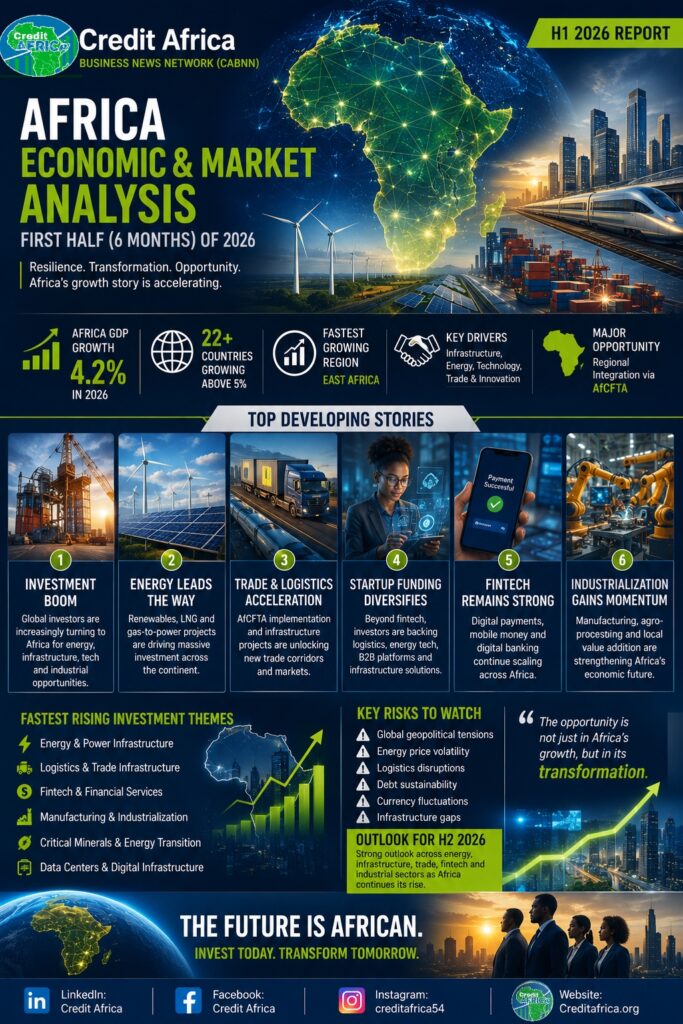
many African economies continue demonstrating strong resilience and growth momentum. According to the latest African Development Bank (AfDB) outlook, Africa is projected to grow by approximately 4.2% in 2026, remaining among the fastest-growing regions globally.
H1 2026 Economic Performance Snapshot
| Indicator | H1 2026 Outlook |
|---|---|
| Africa GDP Growth | 4.2% |
| Economies Growing Above 5% | 22+ Countries |
| Fastest Growing Region | East Africa |
| Key Growth Drivers | Infrastructure, Energy, Technology, Trade |
| Major Opportunity | Regional Integration via AfCFTA |
According to AfDB data, East Africa continues leading continental growth, supported by infrastructure investment, digital transformation, and trade expansion.
Developing Story 1:
Africa Is Becoming A Strategic Investment Destination
One of the biggest stories of 2026 is the growing shift in global investor perception.
Major international institutions increasingly view Africa as a strategic destination for:
- Energy transition projects
- Industrial development
- Technology ecosystems
- Critical minerals
- Infrastructure
This trend was highlighted by global consultancy Alvarez & Marsal opening its first African office, citing rising investor demand tied to critical minerals, infrastructure, and industrial growth opportunities.
CABNN Analysis
The global race for:
- Energy security
- Critical minerals
- Alternative supply chains
is placing Africa at the center of future investment strategies.
Developing Story 2:
Energy Is Becoming Africa’s Biggest Investment Magnet
Energy emerged as one of the most attractive sectors during H1 2026.
Investment attention is increasingly flowing into:
- Solar
- Wind
- Battery infrastructure
- LNG projects
- Gas-to-power systems
Industry analysts project Africa’s next energy expansion cycle will be driven by infrastructure execution rather than resource discovery alone.
Key Trend
Investors are now prioritizing:
✔ Energy infrastructure
✔ Project delivery capacity
✔ Regulatory stability
✔ Power generation scalability
Developing Story 3:
Logistics & Trade Infrastructure Are Accelerating
AfCFTA implementation continues reshaping regional trade opportunities.
Major developments include:
- Cross-border corridors
- Port modernization
- Logistics networks
- Regional supply chains
African leaders recently launched new infrastructure financing initiatives aimed at accelerating AfCFTA implementation and regional connectivity.
CABNN Analysis
The next phase of African growth may be determined by:
- How efficiently goods move
- How quickly borders integrate
- How effectively supply chains scale
Developing Story 4:
African Startup Funding Is Shifting
One of the biggest surprises of H1 2026 has been the diversification of startup investment.
Historically dominated by fintech, investment is now expanding into:
- Logistics technology
- Energy technology
- B2B infrastructure
- Supply chain platforms
African startups raised approximately $575 million during the first two months of 2026, with logistics and energy becoming increasingly attractive sectors.
Market Signal
Investors appear increasingly focused on:
✔ Revenue-generating businesses
✔ Infrastructure-driven innovation
✔ Scalable B2B solutions
rather than purely consumer-focused startups.
Developing Story 5:
Fintech Remains One Of Africa’s Strongest Sectors
Although funding is diversifying, fintech remains a major investment magnet.
Growth continues across:
- Digital payments
- Mobile money
- Digital banking
- Cross-border financial services
Vodacom and Safaricom continue expanding financial services ecosystems across multiple African markets.
Airtel Money also remains positioned as one of Africa’s most significant future fintech listings despite delaying its IPO due to market volatility.
Developing Story 6:
Manufacturing & Industrialization Are Gaining Momentum
Across Africa:
- Industrial parks are expanding
- Export-oriented manufacturing is growing
- Regional value chains are strengthening
AfCFTA continues supporting efforts to move beyond raw material exports toward local value addition and industrial production.
Sectors Attracting Attention
- Agro-processing
- Pharmaceuticals
- Automotive assembly
- Construction materials
- Green industrial manufacturing
Developing Story 7:
Africa Is Relying More On Internal Capital
A major shift emerged in H1 2026:
Africa is increasingly discussing domestic capital mobilization.
Following significant reductions in international aid flows, African institutions are pushing for:
- Pension fund mobilization
- Capital market expansion
- African investment vehicles
- Sovereign investment participation
AfDB estimates Africa faces financing gaps exceeding hundreds of billions of dollars annually while also holding significant institutional capital pools.
CABNN Analysis
The long-term winners may be countries that successfully mobilize:
✔ Domestic savings
✔ Pension assets
✔ Local institutional investors
Fastest Rising Investment Themes (H1 2026)
1. Energy & Power Infrastructure
Strong investor interest across renewables, LNG, and gas-to-power projects.
2. Logistics & Trade Infrastructure
Driven by AfCFTA implementation and regional integration.
3. Fintech & Financial Services
Mobile money and digital finance continue scaling rapidly.
4. Manufacturing & Industrialization
Regional production ecosystems continue expanding.
5. Critical Minerals & Energy Transition Resources
Global supply chain diversification continues driving investor interest.
6. Data Centers & Digital Infrastructure
Growing demand from AI, fintech, and cloud ecosystems.
⚠ Key Risks Investors Are Monitoring
Despite strong momentum, investors remain cautious about:
- Global geopolitical tensions
- Energy price volatility
- Logistics disruptions
- Debt sustainability
- Currency fluctuations
- Infrastructure gaps
The IMF warns that Africa must accelerate productivity reforms and private-sector-led growth to sustain long-term economic expansion.
CABNN Strategic Outlook For H2 2026
The second half of 2026 is expected to be shaped by:
Energy Infrastructure Expansion
Power projects and LNG infrastructure will remain key investment drivers.
AfCFTA Implementation
Regional trade integration will continue accelerating.
Fintech Consolidation
Larger players are expected to expand across borders.
Manufacturing Growth
Regional value chains and industrial ecosystems will gain further momentum.
Domestic Capital Mobilization
Governments and institutions will increasingly focus on local financing mechanisms.
CABNN Conclusion
The first half of 2026 confirms that Africa’s economic story is evolving.
The narrative is increasingly shifting from:
❌ Resource dependency
toward:
✔ Infrastructure development
✔ Regional integration
✔ Industrialization
✔ Technology ecosystems
✔ Energy transformation
✔ Investment-driven growth
The biggest opportunity may no longer be simply investing in Africa.
The opportunity is understanding where Africa is heading before the rest of the market does.
About CABNN
Credit Africa Business News Network (CABNN) provides strategic market intelligence, investment insights, economic analysis, and business opportunities shaping Africa’s future.