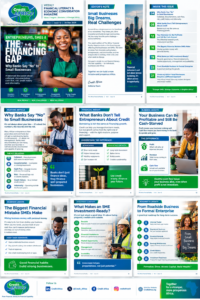
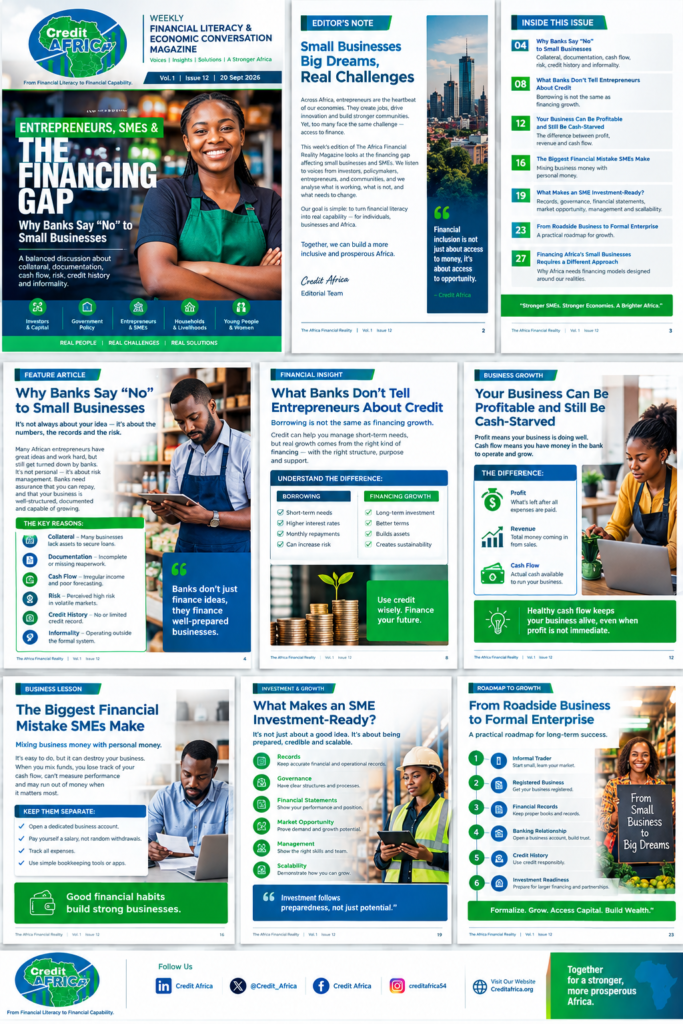
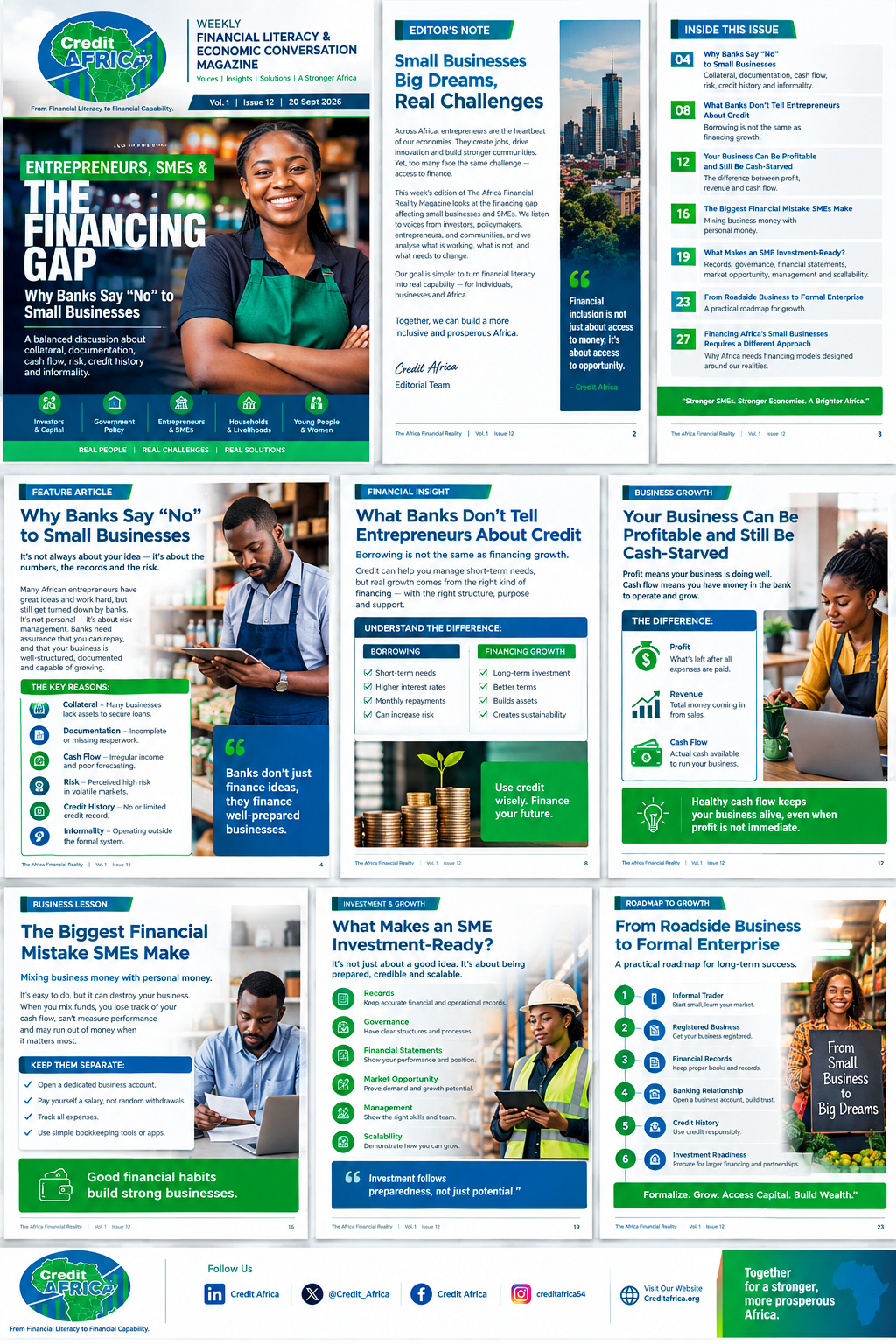
Entrepreneurs, SMEs & the Financing Gap: Why Banks Say “No” to Small Businesses
From Financial Literacy to Financial Capability
Africa has no shortage of entrepreneurs.
Across markets, millions of people are building businesses, creating employment, supplying communities, developing products and services, and turning limited resources into economic activity.
Yet one question continues to confront entrepreneurs across the continent:
Why can a viable small business still struggle to access the finance it needs to grow?
This week’s Credit Africa: The Africa Financial Reality — Weekly Financial Literacy & Economic Conversation Magazine takes a deeper look at one of the most important issues facing African entrepreneurs, SMEs, investors, financial institutions and policymakers:
THE FINANCING GAP
The conversation goes beyond simply asking why a bank rejected a loan application.
It asks a bigger question:
Are Africa’s financial systems sufficiently designed around the realities of African businesses?
According to IFC, MSMEs across Africa continue to face financing constraints associated with factors including insufficient collateral, limited financial records and business plans. IFC estimates the MSME funding gap at approximately US$331 billion in Sub-Saharan Africa. (International Finance Corporation)
That makes SME finance more than a banking issue.
It is a business development issue, employment issue, investment issue and economic-development issue.
WHY DO BANKS SAY “NO” TO SMALL BUSINESSES?
A loan rejection does not necessarily mean that a business has no potential.
From the perspective of traditional credit assessment, however, lenders need sufficient information to understand the business’s ability to repay.
That brings several issues into focus:
1. COLLATERAL
Many small businesses do not possess assets that meet conventional lending requirements.
This can create a structural barrier between entrepreneurial potential and formal credit.
2. DOCUMENTATION
A business may be operating every day and generating sales while still lacking:
- Proper financial statements
- Consistent bookkeeping
- Tax documentation
- Bank statements
- Management accounts
- Formal business records
For a lender, the absence of reliable information increases uncertainty.
3. CASH FLOW
Revenue is not the same thing as cash available to operate a business.
An entrepreneur can have strong sales and still struggle to meet:
- Salaries
- Supplier payments
- Rent
- Transport costs
- Taxes
- Loan repayments
- Inventory requirements
This is why understanding cash flow is one of the most important financial skills an entrepreneur can develop.
4. CREDIT HISTORY
A business without an established credit history may have difficulty demonstrating how it has managed borrowed money previously.
This creates a difficult cycle:
No credit history → limited access to credit → limited opportunity to build credit history.
5. INFORMALITY
Across Africa, significant economic activity takes place outside highly formalized business structures.
Market traders, family enterprises, artisans, agricultural businesses, service providers and small manufacturers can generate real economic value while having limited interaction with formal financial systems.
The challenge is therefore not simply how to “bring informal businesses into banks.”
The deeper question is:
How can financial systems better understand legitimate economic activity that does not yet look like a conventional corporate borrower?
BORROWING IS NOT THE SAME AS FINANCING GROWTH
One of the central lessons in this edition is that credit and growth finance are not necessarily the same thing.
A short-term loan may solve an immediate liquidity problem.
But sustainable business growth can require a different financial structure.
An entrepreneur should therefore ask:
What am I borrowing for?
Is the capital being used for:
- Working capital?
- Inventory?
- Equipment?
- Expansion?
- Property?
- Technology?
- Export development?
- Hiring?
- Production capacity?
- Acquisition of another business?
The purpose of capital matters because the financing structure should make economic sense for that purpose.
YOUR BUSINESS CAN BE PROFITABLE AND STILL BE CASH-STARVED
This is one of the most important financial literacy lessons for SMEs.
PROFIT
What remains after expenses are accounted for.
REVENUE
The money generated from sales.
CASH FLOW
The actual movement and availability of cash within the business.
These three concepts are related — but they are not interchangeable.
A business can report a profit while simultaneously experiencing a cash-flow shortage.
For entrepreneurs, understanding this distinction can change how they approach inventory, customers, suppliers, borrowing and expansion.
THE BIGGEST FINANCIAL MISTAKE SMEs MAKE
Mixing business money with personal money.
It can begin innocently.
A business owner receives sales income and uses some of it for household expenses.
Then another payment arrives.
More withdrawals follow.
Eventually, the entrepreneur can no longer clearly answer:
How much money does my business actually make?
Separating business and personal finances is therefore not merely an accounting exercise.
It is part of building a business that can be measured, managed, financed and eventually invested in.
WHAT MAKES AN SME INVESTMENT-READY?
Having a good business idea is only one part of becoming investment-ready.
Investors and capital providers may need to understand the business’s:
Financial records
Can the financial performance be verified?
Governance
Are responsibilities, ownership and decision-making structures clear?
Management
Does the business have the people and capabilities required to execute its strategy?
Market opportunity
Is there a genuine market for the product or service?
Business model
How does the company generate revenue?
Scalability
Can the business grow without costs increasing at the same rate?
Risk profile
What could prevent the business from achieving its objectives?
Investment readiness is therefore not simply about finding someone willing to provide money.
It is about creating enough structure and information for capital providers to understand what they are financing and why.
FROM ROADSIDE BUSINESS TO FORMAL ENTERPRISE
A small business does not have to become a large corporation overnight.
There can be a progression:
INFORMAL BUSINESS
BUSINESS REGISTRATION
SEPARATE BUSINESS FINANCES
RELIABLE FINANCIAL RECORDS
BANKING RELATIONSHIP
CREDIT HISTORY
INVESTMENT READINESS
BUSINESS GROWTH
Formalization is not the destination by itself.
The objective is to create a business that is increasingly visible, measurable, credible and financeable.
Recent World Bank work in the Democratic Republic of Congo, for example, shows how reducing barriers to formalization can expand entrepreneurs’ access to finance, tenders and employment opportunities. (World Bank)
AFRICA MAY NEED MORE THAN TRADITIONAL CREDIT
The financing challenge also raises a broader question for financial institutions, investors and policymakers.
Should every viable African SME be expected to fit the same traditional lending model?
Financial technology, alternative data, digital banking, risk-sharing mechanisms, blended finance and other financing structures are increasingly being explored as ways of reaching businesses that traditional models may underserve.
IFC’s recent work on MSME banking notes that digital channels, data analytics, innovative business models and partnerships can help financial institutions develop more accessible and tailored MSME financing solutions. (International Finance Corporation)
Recent transactions across African markets also demonstrate growing experimentation with risk-sharing structures and targeted SME finance. IFC, for example, announced 2026 partnerships in Senegal and Kenya aimed at expanding financing to smaller businesses. (International Finance Corporation)
The question is therefore evolving from:
“Why can’t SMEs qualify for existing finance?”
to:
“How can financial systems evolve to finance viable SMEs responsibly?”
THE ENTREPRENEUR’S RESPONSIBILITY
The financing gap is not solely a problem for banks.
Entrepreneurs also have an important role to play.
A business seeking external capital should progressively build:
Financial discipline
Reliable records
Clear ownership structures
A credible business model
Transparent cash flows
Market evidence
Appropriate governance
A clear use of funds
A realistic growth strategy
Capital can accelerate a good business.
But capital cannot substitute for a weak business model, poor financial controls or inadequate management systems.
THE INVESTOR’S QUESTION
Investors also need to look beyond the question:
“Does this business have collateral?”
Other questions can matter:
- Is there a real market?
- Is management capable?
- Are revenues verifiable?
- Is demand growing?
- Can the business scale?
- What is the competitive environment?
- What are the risks?
- What financing structure is appropriate?
- Can additional capital create measurable productive capacity?
This is where the conversation between entrepreneurs and capital providers becomes important.
THE POLICYMAKER’S QUESTION
Government and policymakers also have a role in shaping the environment in which SMEs operate.
Questions include:
- How easy is it to formalize a business?
- How accessible are reliable financial records and digital systems?
- How effective are credit-information systems?
- What mechanisms can responsibly reduce lending risk?
- Are women and young entrepreneurs able to access appropriate financial products?
- Can public-private partnerships expand SME finance?
- How can regulation support innovation without compromising consumer and financial-system protection?
The World Bank has documented both the importance of MSME finance and the mixed evidence surrounding government interventions designed to increase SME credit, highlighting the need to examine how such programmes are structured and implemented. (World Bank Blogs)
THE WOMEN & YOUTH DIMENSION
The financing conversation must also consider who is being left behind.
Women entrepreneurs, young entrepreneurs and informal businesses can encounter different barriers to financial access.
This makes financial inclusion more than simply opening a bank account.
It involves creating pathways from:
Financial access → financial capability → productive finance → business growth.
The World Bank has highlighted continuing gender gaps in financial inclusion and SME finance in African markets, while IFC continues to develop programmes specifically targeting women-owned businesses. (World Bank Blogs)
CREDIT AFRICA COMMUNITY VOICES
This is where the Africa Financial Reality becomes different from a conventional financial publication.
Credit Africa is building a weekly conversation that brings together perspectives from:
Investors
Government & policymakers
Entrepreneurs
SMEs
Households
Young professionals
Young entrepreneurs
Women entrepreneurs
Informal businesses
Financial institutions
Communities across Africa
The objective is not simply to tell people what to think.
It is to listen, analyze, educate and document what African communities are experiencing.
This community-driven approach is central to the framework behind the weekly publication.
THE BIGGER QUESTION
The SME financing gap ultimately raises a much larger economic question:
How do we move African businesses from survival to sustainable growth?
That requires more than loans.
It requires:
Financial literacy.
Financial capability.
Business formalization.
Reliable financial information.
Appropriate financing.
Investment readiness.
Market access.
Digital capability.
Strategic partnerships.
Sound economic policy.
And above all, an ecosystem in which entrepreneurs, financial institutions, investors, governments and communities can participate in the same economic conversation.
FROM SURVIVAL TO ECONOMIC GROWTH
At Credit Africa, we believe financial literacy should not end with knowing how money works.
The larger objective is to help build the knowledge, capability and systems that allow individuals and businesses to make informed financial decisions, access appropriate opportunities and participate more meaningfully in economic growth.
That is the purpose behind:
THE AFRICA FINANCIAL REALITY
Weekly Financial Literacy & Economic Conversation Magazine
Every week, Credit Africa will examine a financial or economic issue through multiple African perspectives — and invite the community to become part of the conversation.
This week’s conversation:
ENTREPRENEURS, SMEs & THE FINANCING GAP
Why Banks Say “No” to Small Businesses
Read the full magazine and explore the complete discussion on Credit Africa.
JOIN THE CONVERSATION
Are you an entrepreneur, SME owner, investor, professional, policymaker or member of an African household?
What is the biggest financial barrier preventing small businesses from moving from survival to growth?
Share your experience. Leave comment.
Your voice can become part of the next Africa Financial Reality conversation