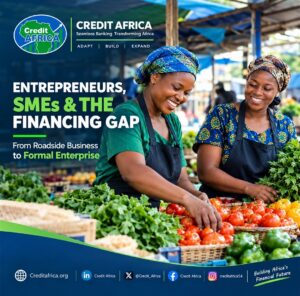
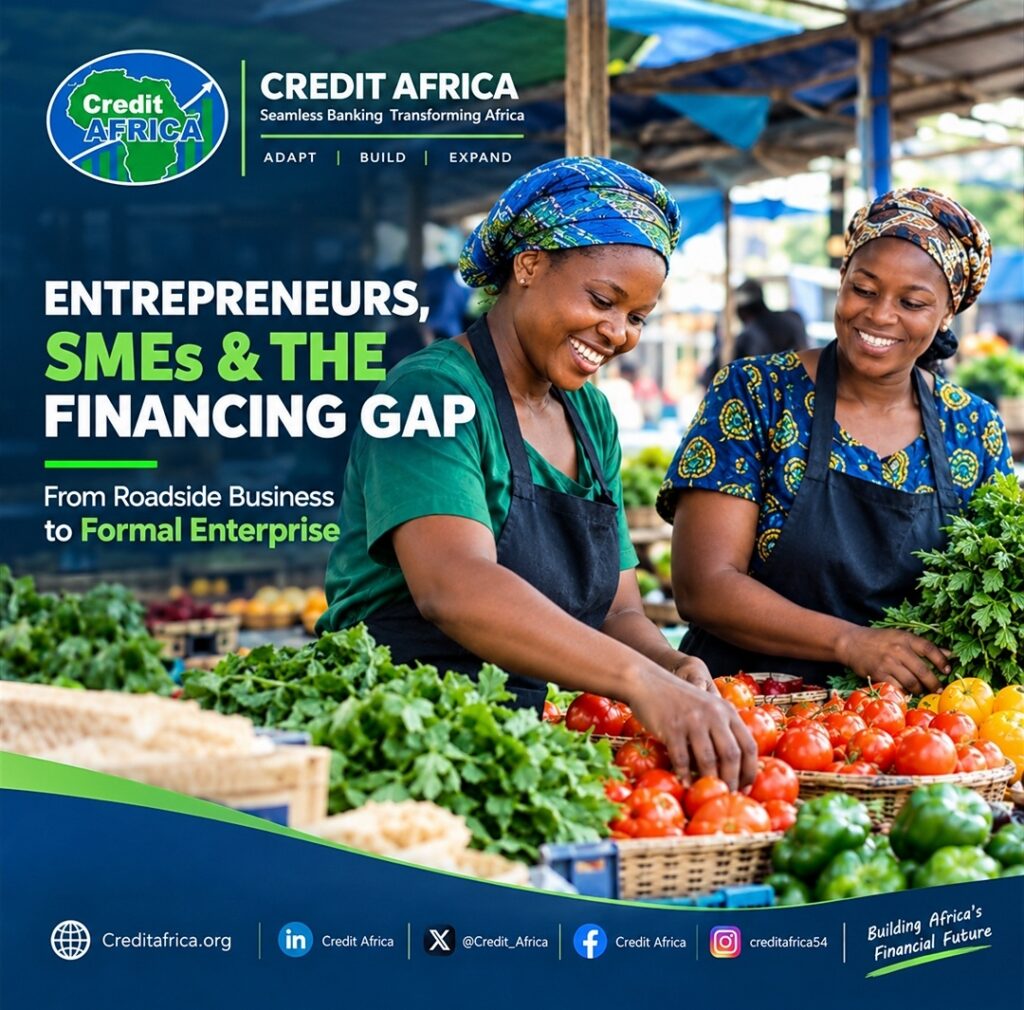
FROM ROADSIDE BUSINESS TO FORMAL ENTERPRISE
- The woman selling vegetables at a market.
- The man running a roadside auto repair business.
- The barber with a busy chair every day.
- The food vendor serving dozens of customers.
- The small shop owner opening before sunrise.
These are not “businesses waiting to start.”
They are already businesses.
The real challenge is helping them move from economic activity to an enterprise that can be documented, financed and scaled.
That journey often looks like this:
INFORMAL TRADER → REGISTERED BUSINESS → FINANCIAL RECORDS → BANKING RELATIONSHIP → CREDIT HISTORY → INVESTMENT READINESS → GROWTH
But each stage requires a different discipline.
1. START WITH THE BUSINESS YOU ALREADY HAVE
Before chasing capital, understand the business.
- What do you sell?
- Who buys?
- How often?
- What are your costs?
- What is your actual margin?
- How much cash comes in and how much goes out?
A business becomes easier to grow when the owner understands its economics.
2. FORMALISE WITH A PURPOSE
Registration should not be treated simply as paperwork.
A properly structured business can create access to opportunities that are harder to reach informally: formal contracts, institutional buyers, tenders, banking relationships and, depending on the jurisdiction and business, finance.
But formalisation alone does not guarantee funding.
It is the beginning of greater visibility not the end of the journey.
3. TURN DAILY SALES INTO FINANCIAL INFORMATION
This is where many small businesses struggle.
You may know exactly how much you sold today.
But can you prove it?
Start simple:
Daily sales.
Expenses.
Inventory.
Debtors.
Creditors.
Cash balance.
Bank transactions.
A basic record kept consistently can become more valuable than a complicated spreadsheet nobody updates.
4. BUILD A BANKING RELATIONSHIP
Use the formal financial system consistently.
Receive business income through the business account where possible.
Pay suppliers.
Deposit sales.
Make payments traceable.
Avoid mixing every personal expense with business cash.
The objective is to create a financial footprint that shows how the business actually operates.
5. BUILD CREDIT HISTORY BEFORE YOU URGENTLY NEED CREDIT
Creditworthiness is built over time.
A lender wants evidence of financial behaviour not only ambition.
Responsible borrowing.
Timely repayment.
Transparent transactions.
Predictable cash flow.
Good financial records.
The entrepreneur who starts preparing only when a major contract arrives is already late.
6. BECOME INVESTMENT-READY
Debt and investment are not the same thing.
A business seeking a working-capital facility needs a different structure from one raising equity to expand into three countries.
Investment readiness means being able to answer:
- How much capital do we need?
- Why do we need it?
- What will it fund?
- What return can the capital generate?
- What are the risks?
- What evidence supports the opportunity?
- Who is accountable for the money?
That is the difference between asking for money and presenting an investable opportunity.
THE REALITY OF AFRICA’S SMALL BUSINESS ECONOMY
Africa does not have a shortage of entrepreneurial activity.
It has a shortage of conversion mechanisms.
Mechanisms that convert:
TRUST → RECORDS
RECORDS → FINANCIAL VISIBILITY
VISIBILITY → CREDITWORTHINESS
CREDITWORTHINESS → CAPITAL
CAPITAL → PRODUCTIVITY
PRODUCTIVITY → GROWTH
That is why the informal trader should not be viewed only through the lens of survival.
The bigger question is:
How do we build the bridge from survival enterprise to sustainable enterprise?
And that requires action from more than the entrepreneur.
Banks need better ways to assess small-business risk.
Fintechs can create better transaction data and digital financial footprints.
Development institutions can provide guarantees, blended finance and capacity-building.
Governments can make formalisation simpler, cheaper and more useful.
And entrepreneurs must build businesses that are increasingly transparent, disciplined and scalable.
THE MOST IMPORTANT SHIFT
We should stop asking only:
“Where can this small business get a loan?”
And start asking:
“What must this business become to responsibly absorb capital?”
Because capital without structure can create debt.
Capital with structure can create capacity.
And capacity can create jobs, tax revenue, supply chains and new investment.
THE ROADMAP IS SIMPLE:
START SMALL.
FORMALISE.
RECORD.
BANK.
BUILD CREDIT.
BECOME INVESTMENT-READY.
SCALE.
The roadside business is not outside Africa’s economy.
It is one of the places where Africa’s next generation of formal enterprises can begin.
The challenge is building the bridge.
QUESTION FOR AFRICAN ENTREPRENEURS:
Which step is hardest today: formalisation, financial records, banking, credit history or becoming investment-ready?
#CreditAfrica #SMEs #Entrepreneurs #AfricanBusiness #AccessToFinance #FinancialInclusion #InvestmentReadiness #BusinessGrowth #Africa #Entrepreneurship