
Credit Africa Business News Network (CABNN)
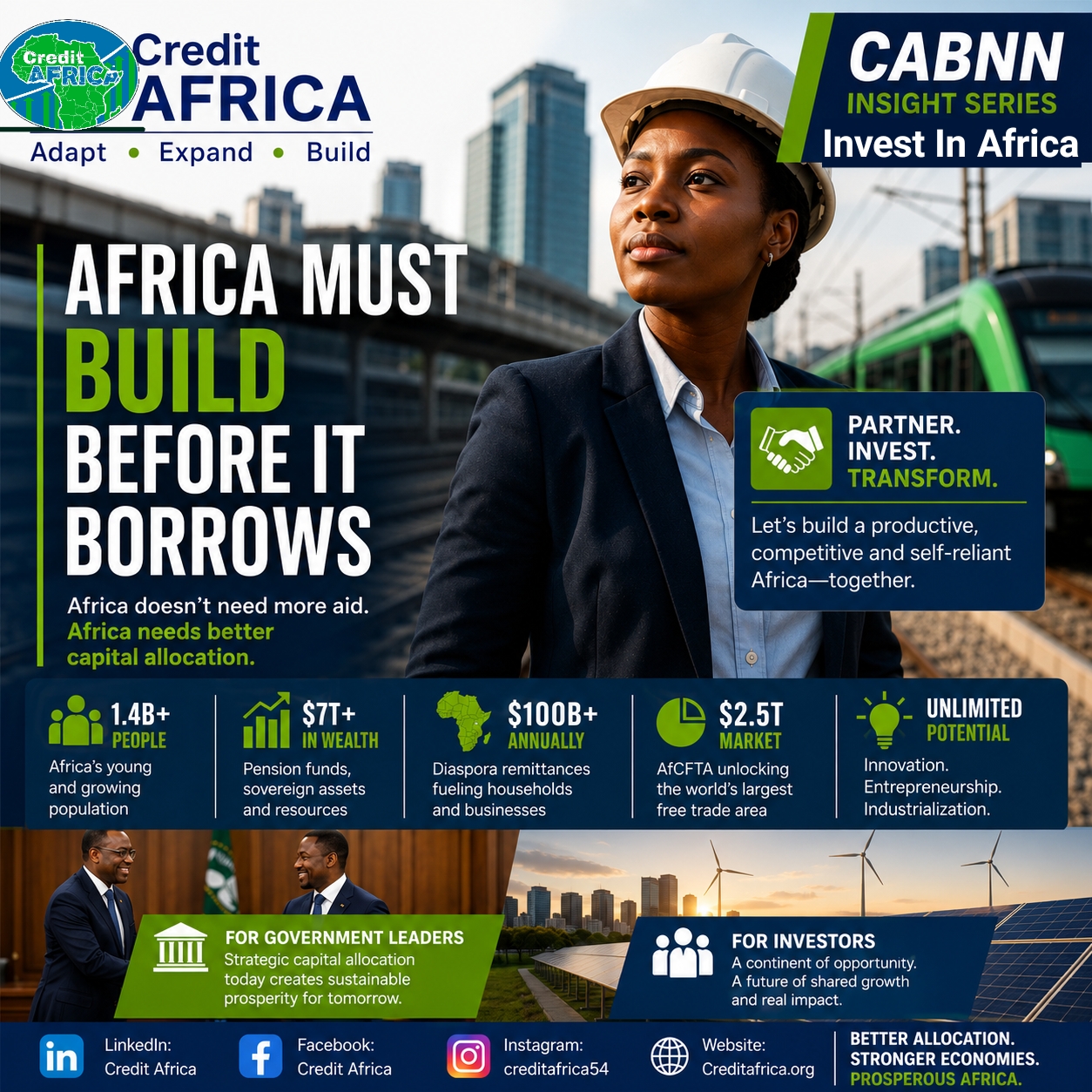
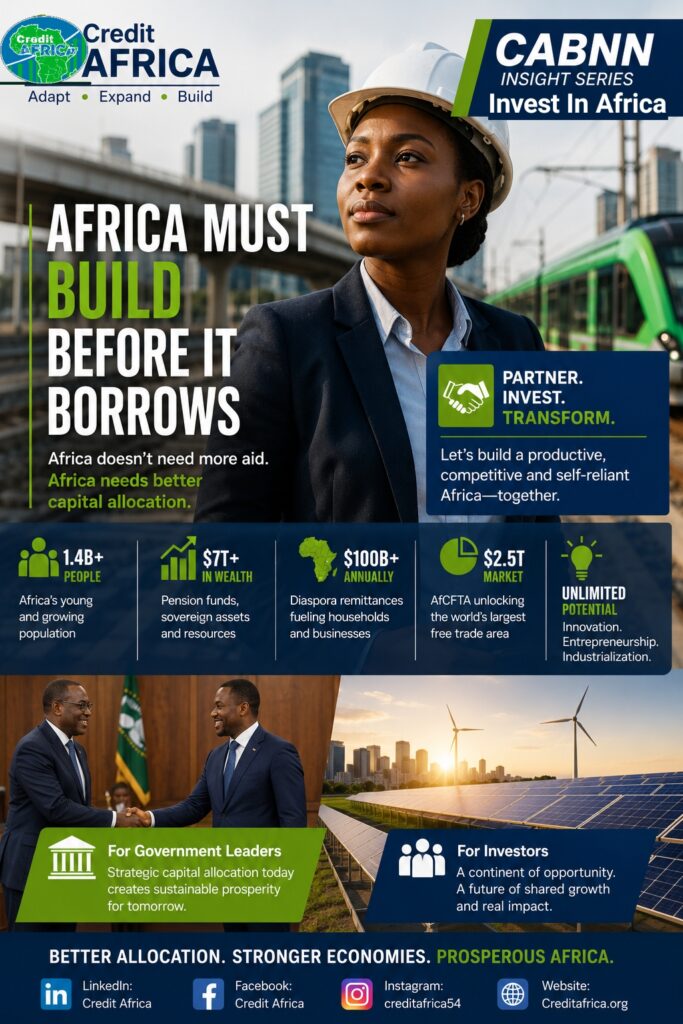
Why Better Capital Allocation, not More Aid, Will Shape Africa’s Future
By Credit Africa Business News Network (CABNN)
Executive Summary
For decades, Africa’s development conversation has largely revolved around aid, concessional loans, and sovereign borrowing. While these financial resources have supported critical sectors such as health, education, and humanitarian response, they have not consistently delivered the structural transformation required to create sustainable prosperity.
Today, Africa stands at a defining moment.
With the world’s youngest population, abundant natural resources, expanding regional markets, and accelerating digital transformation, the continent possesses the foundations to become one of the world’s leading investment destinations. The challenge is no longer whether Africa needs capital—it is whether available capital is being directed toward productive investments that generate long-term economic value.
The future of Africa’s development will depend less on the volume of external financing and more on the quality of capital allocation.
The Case for a New Development Model
Africa accounts for approximately 18% of the world’s population but contributes only around 3% of global GDP and less than 3% of global manufacturing output. This reflects persistent structural challenges in industrialization, infrastructure, and value addition rather than a lack of economic potential.
At the same time:
- Africa hosts some of the world’s largest reserves of critical minerals, including cobalt, manganese, platinum, chromium, and significant copper deposits.
- The continent receives more than US$100 billion annually in diaspora remittances, a source of financing that often exceeds foreign direct investment (FDI) and official development assistance in many countries.
- African pension funds collectively manage hundreds of billions of dollars in long-term assets that could support productive investment.
- The African Continental Free Trade Area (AfCFTA) is creating the world’s largest free trade area by number of participating countries, opening new opportunities for regional manufacturing and trade.
These trends demonstrate that Africa has growing sources of capital and opportunity. The priority is ensuring that they are channelled into sectors that increase productivity and competitiveness.
Why Capital Allocation Matters
Economic history shows that countries achieve sustained growth when investment is directed toward productive assets.
Strategic capital allocation supports:
- Infrastructure that reduces transport and logistics costs.
- Reliable energy systems that power industry.
- Modern agriculture that improves food security.
- Manufacturing that adds value to raw materials.
- Technology that increases productivity.
- SMEs that generate employment and innovation.
By contrast, excessive borrowing for recurrent expenditure or consumption can increase debt without creating the productive capacity needed to repay it.
Development finance is most effective when it expands economic output rather than simply financing expenditure.
Africa’s Strategic Opportunity
Africa’s next phase of development should focus on building competitive economies capable of producing, processing, and exporting higher-value goods and services.
Priority investment sectors include:
Energy
Renewable energy, transmission infrastructure, battery storage, and rural electrification.
Transport & Logistics
Roads, railways, ports, inland logistics hubs, and cross-border trade corridors.
Agriculture & Agro-processing
Commercial farming, irrigation, food processing, cold-chain logistics, and agritech.
Mining & Mineral Beneficiation
Responsible mining, mineral processing, refining, and downstream manufacturing.
Manufacturing
Industrial parks, pharmaceuticals, consumer goods, construction materials, and export-oriented production.
Digital Economy
Fintech, artificial intelligence, broadband infrastructure, cybersecurity, data centres, and digital public services.
Why This Matters to Investors
Global investors are increasingly seeking markets with strong long-term fundamentals.
Africa offers:
- A rapidly growing consumer market.
- One of the world’s youngest workforces.
- Expanding regional integration through AfCFTA.
- Significant infrastructure demand.
- Abundant natural resources.
- Increasing digital adoption.
- Opportunities in renewable energy and climate investment.
As governments continue implementing economic reforms and improving the investment climate, the continent is expected to attract greater interest from institutional investors, sovereign wealth funds, private equity firms, family offices, and development finance institutions.
Credit Africa Insight
Africa does not need to choose between aid and investment. Both have important roles.
However, long-term prosperity will be driven by productive capital—investment that builds industries, strengthens infrastructure, develops human capital, supports entrepreneurs, and creates competitive businesses.
The continent’s greatest opportunity lies in mobilising both domestic and international capital toward sectors that generate employment, expand exports, improve productivity, and strengthen economic resilience.
The objective is not simply to borrow more.
The objective is to build more.
Strategic Partnership Invitation
Credit Africa welcomes collaboration with:
- African Governments
- Ministries of Finance
- Investment Promotion Agencies
- Sovereign Wealth Funds
- Pension Funds
- Development Finance Institutions
- Multilateral Organisations
- Private Equity & Venture Capital Firms
- Commercial Banks
- Corporate Investors
- Philanthropic Foundations
- Chambers of Commerce
- Regional Economic Communities
- Universities & Research Institutions
Together, we can develop investment-ready projects, strengthen public-private partnerships, and accelerate sustainable economic transformation across Africa.
Credit Africa Investment Pipeline
Credit Africa is facilitating investment opportunities in:
- Renewable Energy & Power Infrastructure
- Transport & Logistics Corridors
- Agriculture & Agribusiness
- Mining & Mineral Value Addition
- Manufacturing & Industrial Parks
- Digital Infrastructure & FinTech
- Healthcare & Life Sciences
- Affordable Housing & Urban Development
- Water & Environmental Infrastructure
- SME Growth & Entrepreneurship
We connect investors with credible, high-impact projects that contribute to sustainable economic development.
Practical Recommendation
African governments should prioritise policies that channel public and private capital into productive sectors with high economic multipliers. At the same time, development partners and institutional investors should expand blended finance, public-private partnerships, and long-term investment vehicles that support industrialisation, infrastructure, and SME growth.
Call for Dialogue
Africa’s transformation cannot be delivered by governments alone.
It requires a new partnership between governments, investors, development partners, financial institutions, entrepreneurs, academia, and the private sector.
How can Africa improve capital allocation to finance industrialisation, create jobs, strengthen regional value chains, and reduce dependence on external borrowing?
We invite policymakers, investors, development institutions, business leaders, and researchers to join this important conversation and work together to build a more prosperous, resilient, and globally competitive Africa.
Credit Africa Business News Network (CABNN)
Connecting Africa with investment, policy, business intelligence, and sustainable development.