An African Solution for Sustainable Community Development
By Credit Africa Foundation (CAF)
Across Africa, millions of young people enter the labour market each year with ambition, creativity, and determination. Yet many face unemployment, underemployment, and limited access to practical skills needed to participate in today’s economy.
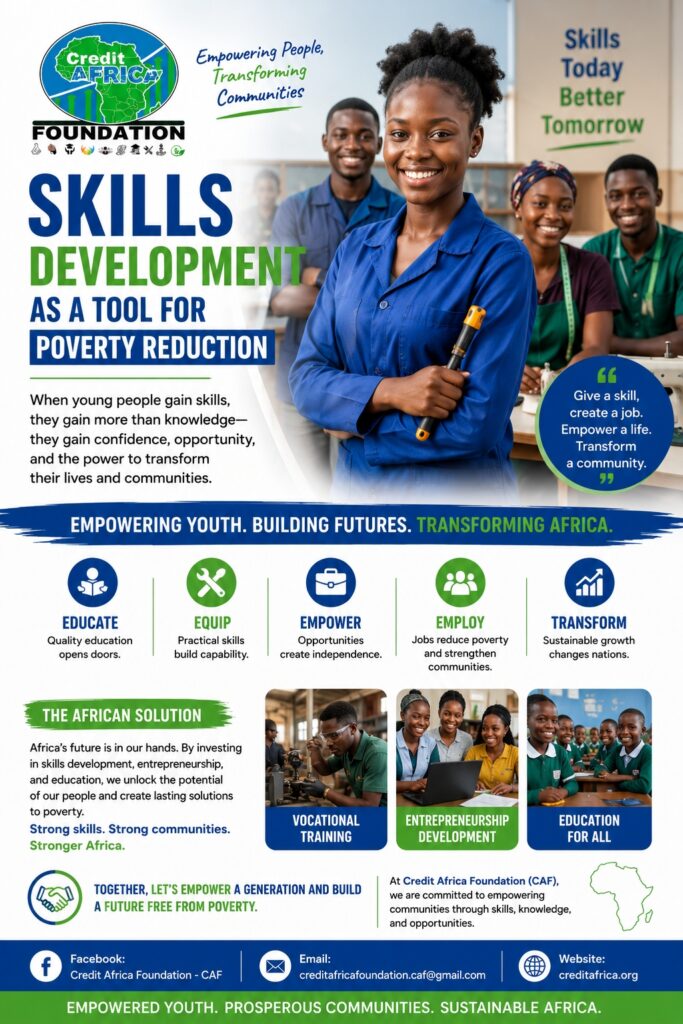
While poverty remains one of Africa’s greatest development challenges, it is also one of its greatest opportunities. By investing in skills development, entrepreneurship, and education, Africa can transform its youthful population into a powerful driver of economic growth and social progress.
At Credit Africa Foundation (CAF), we believe that sustainable poverty reduction begins by empowering people—not merely through financial support, but by equipping them with the skills, knowledge, and opportunities to build their own futures.
The African Concept: Empowering People to Build Their Own Future
For generations, African communities have thrived by sharing knowledge, mentoring younger generations, and passing practical skills from one generation to the next.
This tradition reminds us that development is strongest when communities invest in their own people.
Today’s challenge is to modernize this approach by combining traditional knowledge with technical, digital, vocational, entrepreneurial, and financial skills that prepare young people for a rapidly changing world.
The most sustainable form of aid is not dependency—it is capability.
Why Skills Development Matters
Skills development is more than vocational training. It empowers individuals with the confidence, competence, and resilience needed to improve their lives and contribute meaningfully to society.
When young people acquire relevant skills, they are more likely to:
- Secure meaningful employment.
- Create businesses and employment opportunities.
- Improve household incomes.
- Reduce poverty within their communities.
- Drive innovation and local economic growth.
- Become leaders and mentors for future generations.
Every new skill acquired becomes an investment in Africa’s future.
Youth: Africa’s Greatest Asset
Africa has one of the youngest populations in the world. This demographic presents an extraordinary opportunity.
Rather than viewing youth unemployment as a challenge alone, we should recognize young people as innovators, entrepreneurs, problem-solvers, and community builders.
By investing in youth today, we invest in stronger economies tomorrow.
Youth empowerment should include:
- Entrepreneurship development.
- Digital and technological skills.
- Financial literacy.
- Leadership and civic engagement.
- Vocational and technical education.
- Agricultural innovation.
- Creative industries.
- Green economy and climate resilience skills.
These investments create pathways toward self-reliance and sustainable development.
Education Beyond the Classroom
Quality education should prepare learners for life—not only for examinations.
Communities need education systems that develop critical thinking, creativity, innovation, leadership, and practical skills aligned with labour market demands.
Schools, universities, technical institutions, businesses, NGOs, and governments must work together to bridge the gap between education and employment.
Learning should lead to opportunity.
Community-Led Skills Development
One-size-fits-all solutions rarely succeed.
Every community has unique economic opportunities, cultural strengths, and local industries.
Community-led skills programmes can focus on sectors such as agriculture, manufacturing, digital services, renewable energy, tourism, construction, crafts, and small business development—creating opportunities that are relevant to local realities.
When communities help design training programmes, graduates are more likely to find employment or start sustainable enterprises.
The Role of Humanitarian Organizations
Humanitarian organizations are no longer only providers of emergency assistance—they are partners in long-term development.
By investing in skills development, NGOs and foundations help communities transition from vulnerability to resilience.
The greatest humanitarian investment is creating opportunities that continue long after a project has ended.
Credit Africa Foundation’s Vision
At Credit Africa Foundation (CAF), we are committed to empowering African communities through education, entrepreneurship, financial inclusion, leadership development, and practical skills training.
We envision communities where young people are equipped to create jobs rather than only seek them, where women have equal access to economic opportunities, and where education becomes a pathway to prosperity.
Our mission is to transform potential into productivity and challenges into opportunities.
A Call to Humanitarian Leaders
Africa’s future will not be built by aid alone.
It will be built by investing in people.
We invite NGOs, humanitarian founders, philanthropists, development agencies, corporate CSR leaders, educational institutions, impact investors, and governments to partner with us in expanding access to quality education and market-relevant skills across Africa.
Together, we can empower a generation that will reduce poverty, create businesses, strengthen communities, and accelerate Africa’s sustainable development.
The greatest investment we can make is not in projects—it is in people.
When young people are empowered with skills, they do not simply escape poverty; they become catalysts for economic growth, community resilience, and lasting social impact.
About Credit Africa Foundation
Credit Africa Foundation (CAF) is a community-driven nonprofit organization committed to advancing sustainable development across Africa through education, skills development, entrepreneurship, financial inclusion, youth and women empowerment, humanitarian action, and strategic partnerships.
Follow Credit Africa Foundation -CAF on Facebook:
https://www.facebook.com/share/1cLUhZestQ/
Together, we empower people. Together, we reduce poverty. Together, we build a prosperous Africa.