Why Understanding Funding Matters for African SMEs
Across Africa, thousands of SMEs and startups are searching for:
1. Capital
2. Expansion funding
3. Growth opportunities
Yet many entrepreneurs still struggle with one major challenge:
👉 Understanding which type of funding is best for their business.
Some businesses pursue:
- Grants
- Equity investors
- Loans and debt financing
without fully understanding:
✔ The advantages
✔ The risks
✔ The long-term implications
As Africa’s entrepreneurial ecosystem grows, financial literacy is becoming one of the most important business skills for SMEs.
According to the African Development Bank, Africa’s SME financing gap exceeds $330 billion, highlighting the urgent need for smarter funding access and financial education.
CABNN Insight: Not All Funding Is the Same
One of the biggest mistakes SMEs make is assuming:
👉 “Any money is good money.”
But different funding models serve different purposes.
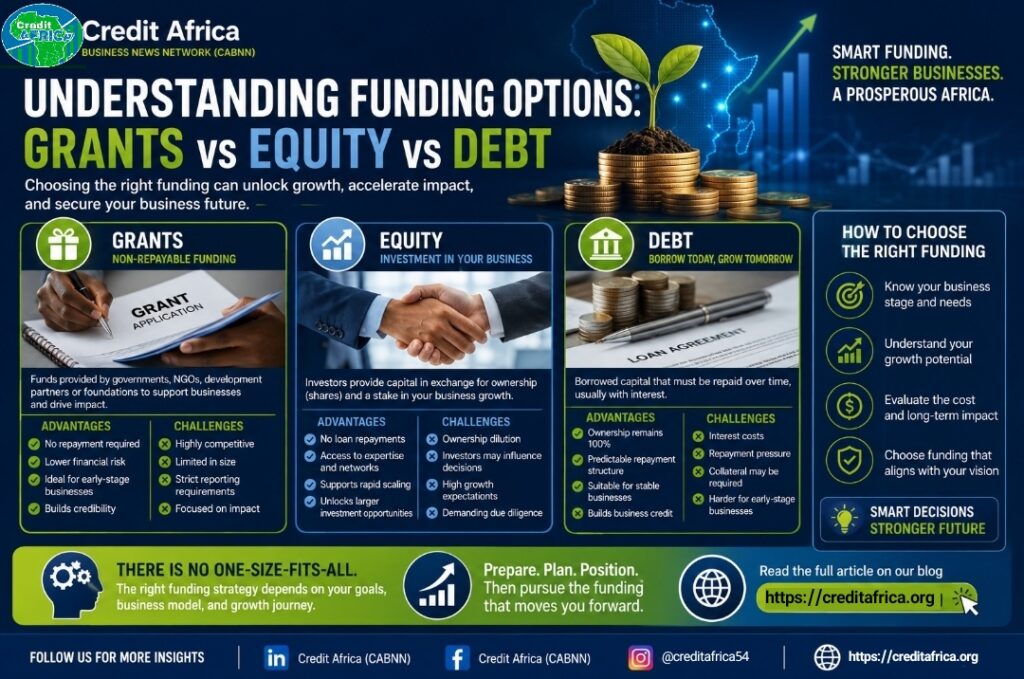
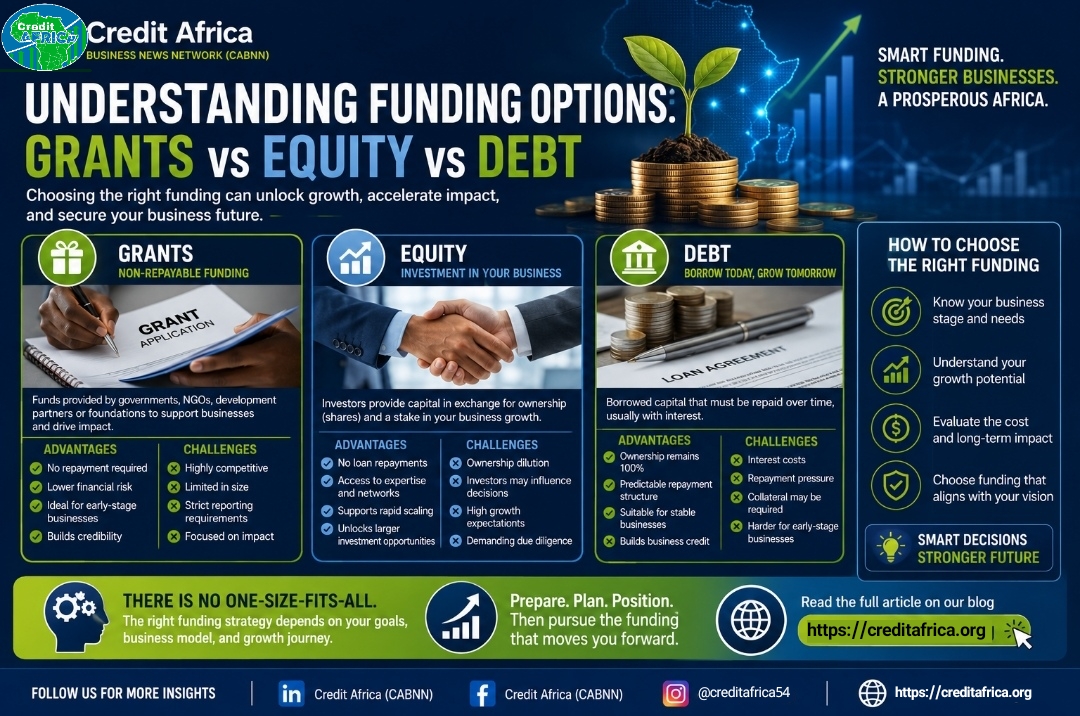
The three most common funding options are:
- Grants
- Equity financing
- Debt financing
Understanding the differences can help entrepreneurs:
✔ Avoid financial pressure
✔ Scale strategically
✔ Protect ownership
✔ Build sustainable businesses
1. Grants: Non-Repayable Funding
✅ What Are Grants?
Grants are funds provided by:
- Governments
- NGOs
- Development institutions
- Foundations
- Innovation programs
that typically do not require repayment.
Grants are often designed to support: ✔ Startups
✔ Youth entrepreneurship
✔ Women-led businesses
✔ Agriculture
✔ Climate innovation
✔ SMEs in underserved sectors
✅ Advantages of Grants
✔ No repayment required
✔ Lower financial risk
✔ Helpful for early-stage businesses
✔ Can improve credibility for future investors
Challenges of Grants
❌ Highly competitive
❌ Often limited in size
❌ May come with strict reporting requirements
❌ Sometimes focused more on impact than scalability
👉 CABNN Perspective:
Grants are excellent for starting or piloting ideas, but they may not always support large-scale business expansion.
2. Equity Financing: Selling a Share of the Business
✅ What Is Equity Funding?
Equity financing involves raising capital from investors in exchange for ownership shares in the company.
Common equity investors include:
- Angel investors
- Venture capital firms
- Private equity firms
- Strategic business partners
Africa’s startup ecosystem continues attracting increasing equity investment, with startups raising over $705 million in Q1 2026 alone.
✅ Advantages of Equity Funding
✔ No monthly loan repayments
✔ Investors may provide mentorship and networks
✔ Supports rapid business scaling
✔ Can unlock larger funding opportunities
Challenges of Equity Funding
❌ Founders give up ownership
❌ Investors may influence decisions
❌ High pressure for growth and returns
❌ Due diligence can be demanding
👉 CABNN Insight:
Equity works best for scalable businesses with strong growth potential.
3. Debt Financing: Loans & Credit
✅ What Is Debt Financing?
Debt financing involves borrowing money that must be repaid over time, usually with interest.
Examples include:
- Bank loans
- SME credit facilities
- Trade financing
- Asset financing
- Microfinance loans
African banks and financial institutions are increasingly developing SME-focused lending products to support entrepreneurship and business growth.
✅ Advantages of Debt Financing
✔ Business ownership remains intact
✔ Predictable repayment structures
✔ Useful for operational growth
✔ Suitable for stable revenue businesses
Challenges of Debt Financing
❌ Interest costs
❌ Repayment pressure
❌ Collateral requirements in some cases
❌ Difficult access for informal businesses
👉 CABNN Perspective:
Debt financing works best when businesses have reliable cash flow and disciplined financial management.
CABNN Comparison: Grants vs Equity vs Debt
| Funding Type | Repayment | Ownership Impact | Best For |
|---|---|---|---|
| Grants | No | None | Early-stage businesses, innovation, social impact |
| Equity | No repayment | Ownership diluted | High-growth scalable businesses |
| Debt | Yes | No ownership loss | Stable revenue-generating businesses |
4. Which Funding Option Is Best for African SMEs?
The answer depends on:
✔ Business stage
✔ Revenue strength
✔ Growth strategy
✔ Risk tolerance
✔ Industry sector
Example:
- Early-stage startup → Grants + incubators
- Fast-scaling tech company → Equity investors
- Established SME with revenue → Debt financing
👉 CABNN Insight:
The smartest entrepreneurs understand how to combine multiple funding sources strategically.
CABNN Business News Highlights
🔹 Africa’s Startup Funding Momentum Continues
African startups continue attracting equity investment, especially in fintech, logistics, and agritech sectors.
🔹 SME Financing Gap Still Exceeds $330 Billion
Access to capital remains one of the biggest barriers for African businesses.
🔹 Development Institutions Increasing SME Support
Governments and financial institutions are expanding SME-focused financing and entrepreneurship programs.
🔹 Investors Increasingly Seeking Investment-Ready SMEs
Businesses with transparency, digital systems, and scalable models are attracting stronger investor interest across Africa.
Practical Funding Tips for African Entrepreneurs
Before seeking funding, SMEs should focus on:
✅ Proper business registration
✅ Financial record keeping
✅ Clear business plans
✅ Revenue tracking
✅ Strong online presence
✅ Market validation
✅ Investor-ready pitch decks
👉 CABNN Perspective:
Funding follows preparation.
What Investors & Lenders Want to See
Whether seeking grants, equity, or loans, funders increasingly evaluate:
✔ Financial discipline
✔ Scalability
✔ Market demand
✔ Leadership quality
✔ Digital adoption
✔ Governance systems
Businesses that demonstrate structure and professionalism stand out faster.
Common Mistakes SMEs Make When Seeking Funding
❌ Seeking funding too early
❌ Poor financial records
❌ No scalability strategy
❌ Applying for the wrong funding type
❌ Mixing personal and business finances
👉 CABNN Insight:
The wrong funding model can slow business growth instead of accelerating it.
CABNN Perspective: Financial Education Is a Competitive Advantage
Africa’s entrepreneurial ecosystem is evolving rapidly.
But many SMEs still lack:
1. Financial literacy
2. Funding strategy knowledge
3. Investment readiness preparation
The businesses that understand capital structures and funding strategy will gain a major competitive advantage in the years ahead.
📣 Smart Funding Can Transform African Businesses
Across Africa:
1. Startups are scaling
2. Fintech businesses are attracting investment
3. Agribusinesses are modernizing
3. SMEs are expanding regionally
But growth requires:
✔ Smart capital
✔ Financial discipline
✔ Strategic funding decisions
The future belongs not only to businesses that find funding, but to businesses that understand how funding works.
🌐 About CABNN
Credit Africa Business News Network (CABNN) delivers strategic business insights, SME growth strategies, investment opportunities, and economic analysis shaping Africa’s future.
👉 Explore more insights at: Credit Africa