
Investment-ready businesses Africa
How SMEs attract investors
Why Investment-Ready SMEs Matter in Africa
Small and Medium Enterprises (SMEs) are the backbone of Africa’s economy.
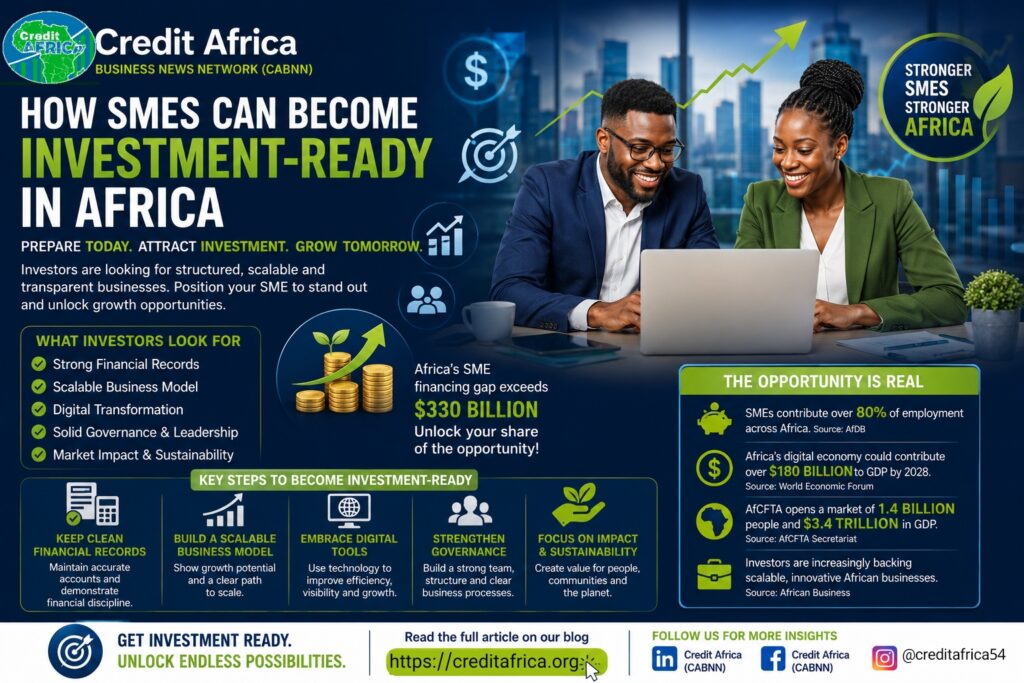
Across the continent, SMEs contribute: ✔ Over 80% of employment
✔ Significant economic activity
✔ Innovation and entrepreneurship growth
Yet despite their importance, many African SMEs still struggle to access:
- Funding
- Investors
- Expansion capital
- Trade financing
According to the African Development Bank, Africa faces an SME financing gap exceeding $330 billion, limiting business growth and economic expansion.
But a major shift is happening.
Investors are increasingly looking toward African SMEs as:
New growth engines
Scalable business opportunities
Drivers of economic transformation
The key challenge is no longer only finding investors.
👉 It is becoming investment-ready.
CABNN Insight: What Investors Look for in African SMEs
Investors today are not simply funding ideas.
They are looking for businesses that demonstrate:
✔ Structure
✔ Transparency
✔ Scalability
✔ Financial discipline
✔ Market opportunity
African SMEs that prepare properly are increasingly attracting:
- Venture capital
- Impact investment
- Trade financing
- Strategic partnerships
- Development finance support
👉 CABNN Perspective:
Investment readiness is becoming a competitive advantage for African businesses.
1. Build Strong Financial Records
One of the biggest reasons SMEs fail to attract investors is poor financial documentation.
Investors want to see:
✔ Revenue records
✔ Expense tracking
✔ Profit margins
✔ Cash flow visibility
✔ Tax compliance
SMEs that maintain accurate financial statements build:
👉 Credibility and investor confidence.
Digital accounting tools and mobile finance platforms are increasingly helping African SMEs improve financial management.
2. Develop a Scalable Business Model
Investors look for businesses capable of growth beyond a single location or customer base.
Questions investors often ask include:
- Can the business scale regionally?
- Is demand increasing?
- Can operations expand efficiently?
- Does the model solve a major market problem?
The African Continental Free Trade Area (AfCFTA) is creating new opportunities for SMEs to expand across borders and reach larger markets.
👉 CABNN Insight:
Scalability is one of the most important signals investors evaluate.
3. Embrace Digital Transformation
Digital adoption is rapidly becoming essential for business competitiveness.
Investment-ready SMEs increasingly use:
✔ Digital payments
✔ E-commerce platforms
✔ Social media marketing
✔ CRM systems
✔ Online accounting tools
Africa’s digital economy could contribute over $180 billion to GDP by 2028, creating significant opportunities for digitally enabled SMEs.
Businesses with strong digital systems often appear:
✔ More efficient
✔ More transparent
✔ More scalable
to investors and lenders.
4. Build Strong Governance & Leadership
Investors are not only investing in products.
They are investing in:
✔ Leadership
✔ Decision-making systems
✔ Operational discipline
SMEs should establish:
- Clear management structures
- Defined business roles
- Legal registration
- Governance policies
Businesses with strong leadership and accountability are more likely to attract long-term partnerships and funding.
5. Focus on Market Impact & Sustainability
Modern investors increasingly evaluate:
✔ Environmental impact
✔ Social impact
✔ Sustainability
✔ Job creation potential
This is especially true for:
- Impact investors
- ESG-focused funds
- Development finance institutions
African SMEs solving:
– Agricultural challenges
– Energy access
– Financial inclusion
– Logistics gaps
are increasingly attracting attention from global investors.
CABNN Business News Highlights
🔹 Africa’s SME Financing Gap Still Exceeds $330 Billion
Development institutions continue prioritizing SME financing across Africa due to the sector’s importance in employment and economic growth.
🔹 Digital Adoption Accelerating Among African SMEs
Businesses using digital tools are improving operational efficiency and access to markets.
🔹 AfCFTA Opening Cross-Border Opportunities for SMEs
Regional trade integration is creating larger markets for African entrepreneurs and manufacturers.
🔹 Investors Increasingly Interested in Scalable African Businesses
Fintech, agritech, logistics, and renewable energy SMEs continue attracting investment across Africa.
Practical Steps SMEs Can Take Today
Here are immediate actions African SMEs can begin implementing:
✅ Register the business legally
✅ Separate business and personal finances
✅ Maintain proper accounting records
✅ Build a strong online presence
✅ Develop a growth strategy
✅ Create professional pitch materials
✅ Improve operational transparency
✅ Focus on customer trust and consistency
👉 CABNN Perspective:
Investment readiness starts with discipline before funding.
What This Means for African Entrepreneurs
Africa’s SME ecosystem is entering a new era.
The businesses that position themselves properly today could become:
– Regional brands
– Scalable enterprises
– Investment-backed companies
– Future industry leaders
But preparation matters.
Investors increasingly seek:
✔ Organized businesses
✔ Data-driven operations
✔ Clear market opportunities
✔ Strong leadership teams
Challenges SMEs Still Face
African SMEs continue facing:
- Limited access to capital
- Currency volatility
- Infrastructure gaps
- Regulatory barriers in some markets
However, digital transformation, AfCFTA, and growing investor interest are helping reduce some of these barriers.
CABNN Perspective: Africa’s SMEs Are the Future of Economic Growth
The future of Africa’s economy will not be built by large corporations alone.
It will increasingly be driven by:
✔ SMEs
✔ Startups
✔ Young entrepreneurs
✔ Innovation-led businesses
The key challenge now is ensuring African SMEs become:
👉 Globally competitive and investment-ready.
📣 Investment Readiness Is the New Business Advantage
Across Africa:
– Digital businesses are scaling
– Agritech SMEs are modernizing agriculture
– Fintech startups are expanding financial inclusion
– Logistics companies are connecting markets
The opportunity is growing.
But investors are increasingly backing businesses that are:
✔ Structured
✔ Transparent
✔ Scalable
✔ Prepared for growth
In Africa’s evolving economy, investment readiness may become one of the most important competitive advantages for SMEs.
🌐 About CABNN
Credit Africa Business News Network (CABNN) delivers strategic business insights, SME growth strategies, investment opportunities, and economic analysis shaping Africa’s future.
👉 Explore more insights at: Credit Africa