Africa is not short of ambition.
It is not short of resources.
Yet across the continent, development continues to lag behind potential.
Why?
Because many economies, and the businesses within them are caught in a cycle of debt that delays real progress.
This is not just a financial issue.
It is a structural challenge shaping Africa’s growth trajectory.
Understanding the Debt Cycle
Debt, in itself, is not the problem.
In fact, when used strategically, it can accelerate development.
The problem arises when debt becomes:
• Consumption-driven rather than production-driven
• Short-term focused instead of long-term structured
• Poorly managed due to low financial literacy
Across many African economies, debt is often used to:
• Fund imports instead of local production
• Cover budget deficits without building sustainable revenue systems
• Support businesses that are not structured for growth
This creates a loop:
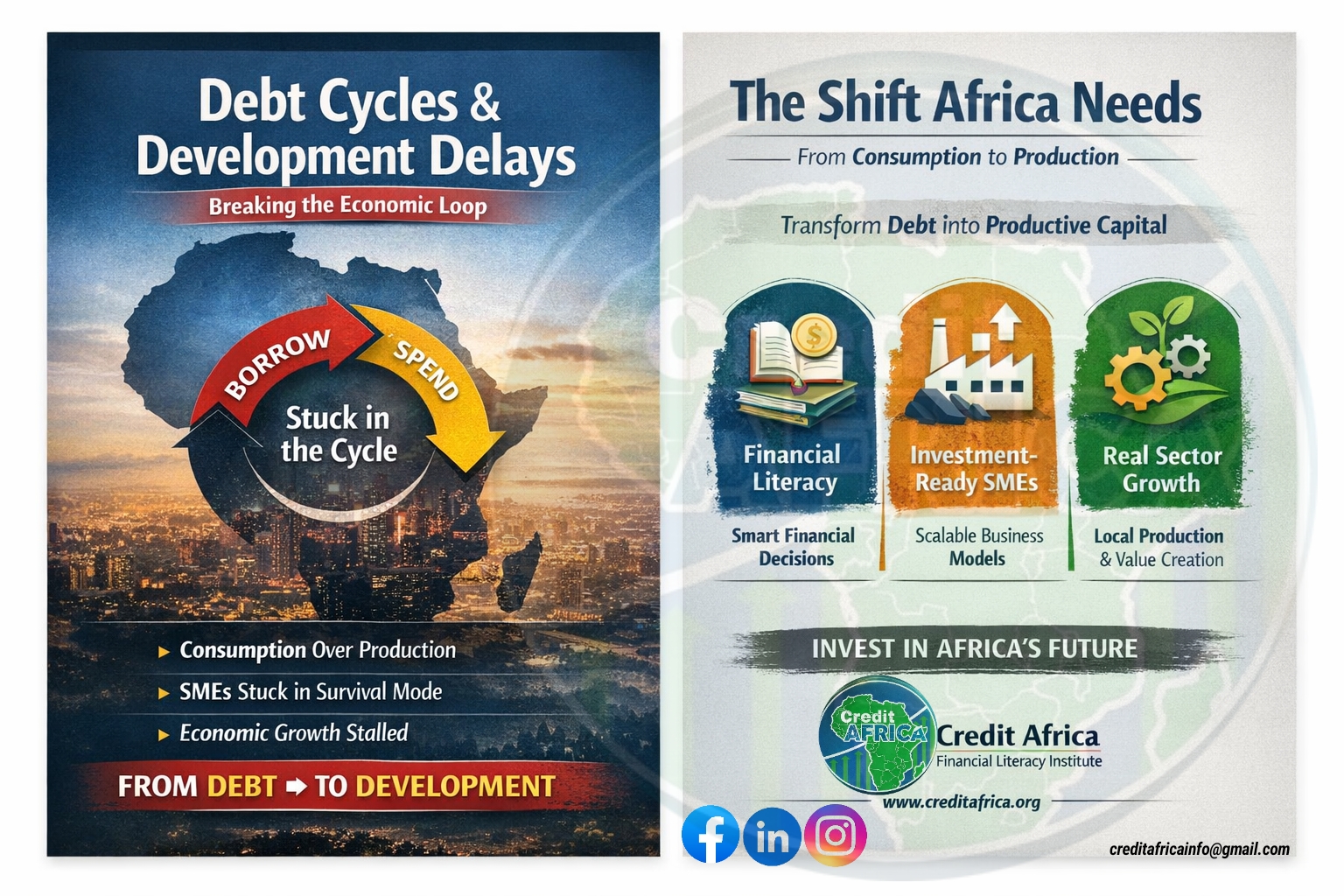
👉 Borrow -To- Spend -To- Limited return -To- Borrow again
A cycle that sustains activity, but delays transformation.
The Cost of Development Delays
When debt is misaligned with productivity, the consequences are significant:
• Slower industrialization
• Weak SME growth and scalability
• Increased dependency on external financing
• Currency and inflation pressures
• Reduced investor confidence
At the micro level, SMEs face a similar pattern:
• Loans without financial strategy
• Cash flow mismanagement
• Growth without structure
• Eventual stagnation or collapse
The result?
👉 Economies remain consumption-driven
👉 Businesses remain survival-focused
👉 Opportunities remain underutilized
Where the Real Gap Lies
The challenge is not simply “too much debt”,
It is how debt is structured, deployed, and managed.
Three key gaps stand out:
1. Financial Literacy Gap
Many individuals and business owners lack the tools to:
– Manage debt effectively
– Align borrowing with revenue generation
– Build sustainable financial systems
2. Structural Investment Gap
– Capital is available, but often:
– Not aligned with real sector opportunities
– Not structured for SME scalability
– Not linked to measurable productivity outcomes
3. Production Gap
Too much borrowing supports:
– Consumption and imports
Instead of:
– Local production and value creation
From Debt Dependency to Productive Capital
To break the cycle, Africa must rethink debt, not as a burden, but as a tool for structured growth.
This requires:
✔ Linking debt to productive sectors (agriculture, manufacturing, processing)
✔ Building investment-ready SMEs
✔ Strengthening financial literacy at all levels
✔ Designing capital structures that prioritize scalability and returns
This is how we move from:
➡️ Debt cycles -To- Capital cycles
➡️ Consumption -To- Production
➡️ Delays -To- Sustainable development
The Role of Credit Africa (CAFLI)
At Credit Africa Financial Literacy Institute (CAFLI), we are addressing this challenge at its core.
Our approach focuses on:
• Transforming financial literacy into practical economic tools
• Preparing SMEs to become structured and investment-ready
• Bridging the gap between capital and real sector opportunities
• Supporting models that generate sustainable, high-yield returns
Because development is not driven by debt alone,
It is driven by how effectively capital is used.
A Call to Investors & Strategic Partners
Africa’s future will not be built by avoiding debt,
But by deploying capital more intelligently.
At Credit Africa, we are advancing multiple SME-driven projects that are:
• Built on strong financial structures
• Focused on real sector productivity
•Designed for scalability and high-yield revenue
• Positioned to deliver both impact and returns
This is an opportunity to be part of a new economic narrative,
One where capital drives production, growth, and long-term value creation.
Breaking the Cycle, Building the Future
Debt cycles may have delayed development,
But they do not have to define the future.
With the right combination of:
👉 Financial literacy
👉 Structured investment
👉 Scalable SME ecosystems
Africa can shift from borrowing to build consumption
To investing to build prosperity.
Explore Investment & Partnership Opportunities
If you are:
• An investor seeking high-impact, high-return opportunities
• A financial institution or development partner
• A strategic collaborator in economic transformation
We invite you to engage with us.
👉 For more information on current investment opportunities and partnerships, visit:
creditafrica.org
Join the Conversation
How can Africa better align debt with development?
Share your insights and be part of shaping the future.
#DebtManagement #EconomicDevelopment #FinancialLiteracy #InvestInAfrica #SMEGrowth #ImpactInvesting #AfricaRising #WealthCreation #CreditAfrica #SustainableFinance