
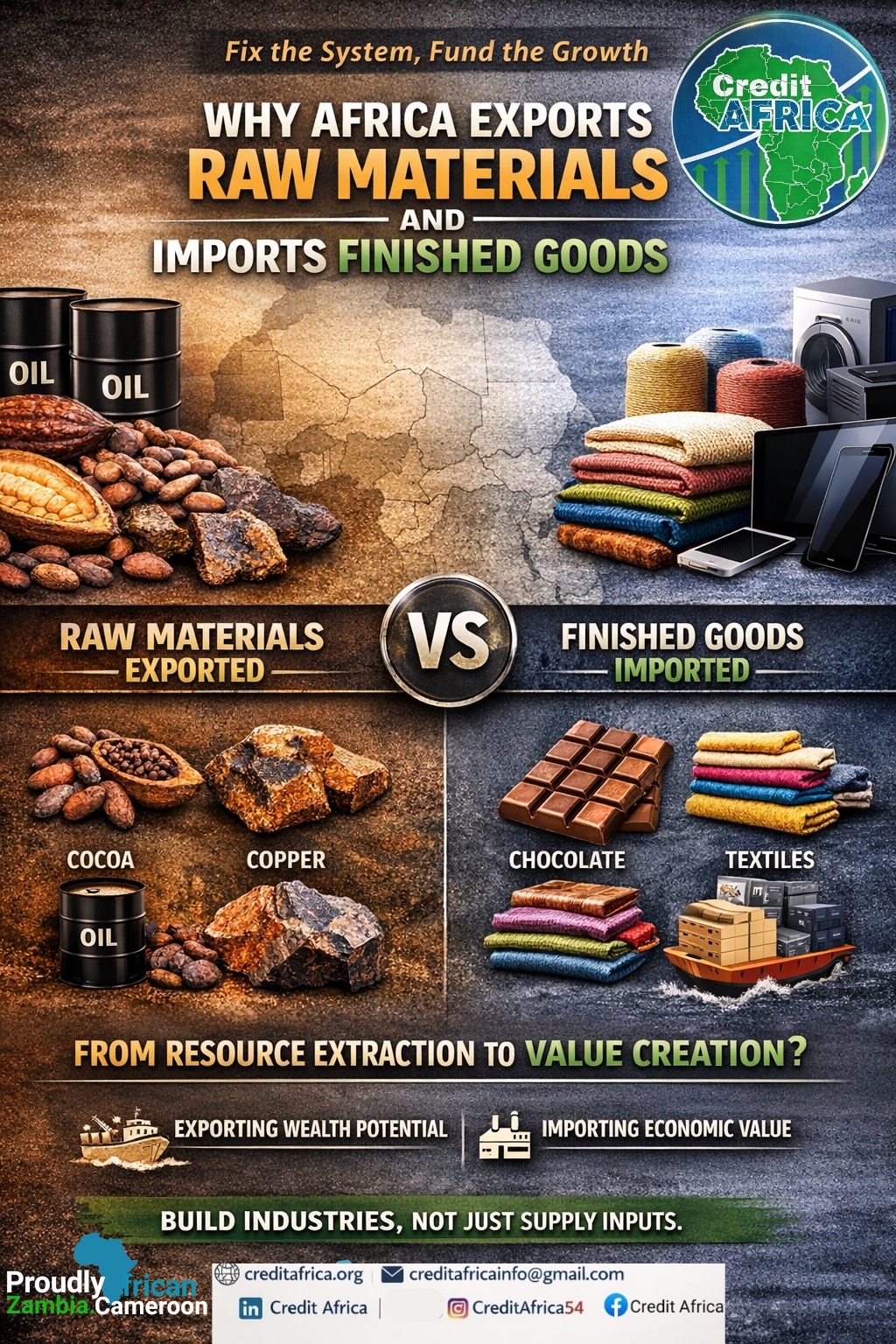
As we continue this series on structural transformation in Africa, a critical question emerges:
Why is it easier to finance imports than to finance local production?
Across many African economies, banks readily finance:
- Import letters of credit
- Wholesale consumer goods
- Processed food imports
- Finished industrial products
Yet financing local production, agriculture, manufacturing, agro-processing often faces far greater hurdles.
This imbalance has long-term economic consequences.
Africa spends tens of billions of dollars every year importing goods that could be produced locally, from food products to basic manufactured items.
This is not simply a trade issue.
It is a financing structure issue.
Why Import Financing Is Easier
Financial institutions operate on risk models.
Imports often appear safer because they come with:
- Established global suppliers
- Predictable delivery contracts
- Insured shipping
- Documented trade instruments
- Faster turnover cycles
With tools like trade finance instruments, risk is structured and measurable.
Capital follows certainty.
Why Local Production Struggles to Secure Finance
Local production is inherently more complex.
It requires financing across multiple layers:
- Raw material sourcing
- Equipment and infrastructure
- Skilled labor
- Energy and logistics
- Processing and distribution
In many cases, producers lack:
- Structured value chains
- Bankable documentation
- Contract-backed off-take agreements
- Risk mitigation frameworks
Without these systems, lenders perceive higher risk.
And where risk is high, capital retreats.
The Structural Consequence
When financing favors imports over production, economies experience:
- Persistent trade deficits
- Weak industrialization
- Job losses in domestic sectors
- Currency pressure from foreign exchange demand
Most importantly, nations remain consumers instead of producers.
The Financial Intelligence Shift
The solution is not simply “produce more.”
It is to finance differently.
Local production becomes bankable when systems are built around it:
Structured supply chains
✔ Aggregation models
✔ Contract-based off-take agreements
✔ Warehouse and logistics infrastructure
✔ Risk-sharing financial frameworks
When these systems exist, capital can move confidently into production sectors.
The Strategic Imperative
Africa’s economic transformation will not be driven by imports.
It will be driven by structured production ecosystems.
Capital must shift from financing consumption to financing capacity.
Because the real question is not:
“Can Africa produce?”
The question is:
“Are we structuring production to meet the standards of institutional finance?”
At Credit Africa, we believe sustainable prosperity will come when financial systems support the full value chain of local production, from farm and factory to market and export.
Because real economic power is built by producing, not just purchasing.
#CreditAfrica
#FixTheSystem
#FundTheGrowth
#CapitalWithStructure
#AfricanFinance
#IndustrializationAfrica
#TradeFinance
#DevelopmentFinance
#FinancialIntelligence
#AfricaRising